Updated June 20, 2026
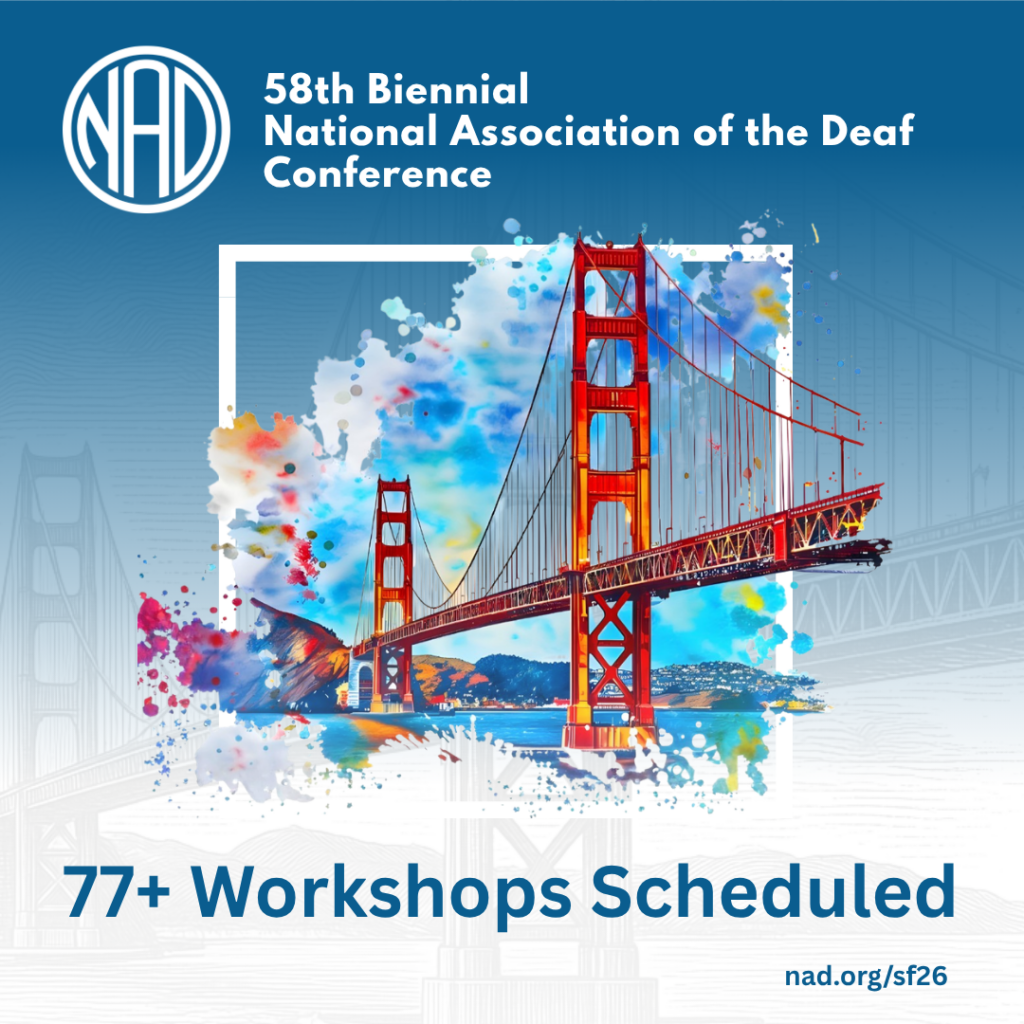
Workshops and training sessions for the 58th Biennial National Association of the Deaf (NAD) Conference are now listed with available scheduling details, including dates, times, meeting room assignments, and CEU information.
Sacramento Valley Registry of Interpreters for the Deaf (SaVRID) is the approved Certificate Maintenance Program (CMP) sponsor for the 58th Biennial National Association of the Deaf Conference. Workshops offered during the conference qualify for RID CEUs, with each session clearly labeled by CEU value, content area, and knowledge level.
Conference workshop offerings are also made possible through close collaboration with our organizational partners: RID Region V, Deaf in Government, and NAD Education Section.
Target Audience: Deaf community members, professionals, educators, interpreters, advocates, policymakers, students, families, and organizations interested in advancing access, equity, and innovation across Deaf-centered systems and services.
Cancellation and Refund Policy: All registrations are non-refundable. In cases of medical or personal emergencies, exceptions may be considered with supporting documentation ([email protected]).
Accessibility Requests: We are committed to making this conference accessible. If you require accommodations, please include detailed information when registering online. To assist with planning, please submit requests by May 20, 2026. After this date, accommodations will depend on availability.
Nondiscrimination Policy: The NAD and SaVRID are committed to fostering an inclusive, equitable, respectful, and non-discriminatory environment for all participants. We do not discriminate on the basis of race, color, national origin, religion, sex, gender identity or expression, sexual orientation, age, disability, veteran status, or other protected characteristics, and ensure equal access to all programs, services, and activities.
Questions or Feedback: Participants are encouraged to complete workshop evaluations and may also submit compliments, concerns, or complaints related to conference workshops ([email protected]).
View Full Workshop & Training Session Listing
No workshops match your search.
Download Workshops & Training Sessions Visual Grid (PDF)


Time: 8:00–9:00 AM
Location: Continental 1
Title: Designing Customer Service for Deaf PeopleTrack: Technology and Innovation
Presenters: Rogelio Fernández Mota, Cameron Papazis, MBA
Rogelio Fernández Mota is Vice President of Access Services at Communication Service for the Deaf (CSD), leading strategy, operations, and growth for interpreting, VRI, captioning, and on-demand access services nationwide. A 30-year CSD veteran, he focuses on expanding coverage, strengthening workforce readiness, building partnerships, and advancing sustainable, Deaf-centered communication access at scale.
Cameron Papazis, MBA, is a Business Development Manager at Communication Service for the Deaf (CSD), expanding Direct Video Calling (DVC) through partnerships with organizations and agencies. She helps clients implement accessible communication solutions that enable deaf and hard of hearing individuals to connect directly and effectively, improving real-world customer interactions.
Despite decades of innovation in communication technology, customer service access for Deaf and Hard of Hearing people has not progressed at the same pace. Many organizations still rely on third-party solutions like Relay Services, even though these models introduce delays, misunderstandings, and a different experience than hearing customers receive. Increasingly, Deaf consumers are asking a simple question: Why can’t we communicate directly? Direct Video Calling (DVC) offers an alternative. By enabling point-to-point communication in American Sign Language between Deaf consumers and organizations, without interpreters or intermediaries, DVC delivers faster calls, greater clarity, and more accurate outcomes. Most importantly, it creates an experience equivalent to traditional voice customer service. So how are organizations like Comcast, Walmart, and Google rethinking access and raising the bar for Deaf customer experience? In this session, Communication Service for the Deaf (CSD) will explore why direct access must replace accommodation-based approaches as the standard for customer service and public-facing communication. Presenters will unpack barriers, challenge assumptions about accessibility, and share practical, scalable strategies attendees can apply within their organizations.
- Identify key barriers that limit effective customer service access for Deaf and Hard of Hearing consumers.
- Explain the differences between Video Relay Service (VRS) and Direct Video Calling (DVC).
- Analyze how communication models impact equity and access for Deaf consumers.
- Apply practical strategies to improve direct communication access in their professional settings.
Content Area: Professional Studies
Knowledge Level Required: Little/None

Time: 8:00–9:00 AM
Location: Continental 2
Title: Designing Professional Development for Teachers of Deaf-PlusTrack: Professional Practice and Expertise
Presenter: Millicent Musyoka, Ph.D.
Millicent Musyoka, Ph.D., is a professor in the Department of Deaf Studies and Deaf Education at Lamar University. She holds a doctorate in Deaf Education from Gallaudet University. Her research interests include early language and literacy development in Deaf children, Deaf learners with multiple disabilities, Deaf multilinguals, and Deaf teacher education.
Deaf students with additional disabilities (DSAD) are an expanding yet often overlooked group within both Deaf and special education. Their needs frequently fall between these two fields. Deaf education teachers are trained to work with Deaf or Hard of Hearing students with language delays, but may lack the skills to address complex learning needs associated with additional disabilities. Conversely, special education teachers are prepared to support diverse learners but often lack expertise in Deaf students’ language, communication, and learning styles. As a result, DSAD are often underserved because neither system fully addresses their needs. This presentation focuses on innovative approaches to professional development that bridge these fields, equipping teachers with the knowledge, tools, and collaborative skills needed to support these students effectively.
- Identify the educational gaps experienced by Deaf students with additional disabilities.
- Demonstrate integrated professional development models that connect Deaf education with special education.
- Identify practical strategies that meet the learning needs of Deaf students with additional disabilities.
Content Area: Professional Studies
Knowledge Level Required: Little/None


Time: 8:00–9:30 AM
Location: Franciscan AB
Title: Dialogue with the Federal Communications Commission about AccessibilityTrack: Policy, Rights, and Advocacy
Presenters: Joshua Mendelsohn, J.D., Suzy Rosen Singleton, J.D.
Joshua Mendelsohn, J.D., is an Attorney Advisor with the FCC’s Disability Rights Office, advancing accessibility in video, communications, and emergency services. He serves as Co-Designated Federal Officer of the FCC’s Consumer Protection and Accessibility Advisory Committee. He previously held leadership roles with the Massachusetts Rehabilitation Commission and the U.S. Department of Justice Civil Rights Division.
Suzy Rosen Singleton, J.D., is Chief of the Disability Rights Office within the Consumer and Governmental Affairs Bureau of the Federal Communications Commission (FCC). Since 2016, she has led rulemaking and stakeholder efforts to ensure accessibility of emergency communications, modern technologies, and video programming for people with disabilities. Her career spans disability policy roles with the National Association of the Deaf, U.S. Department of Education, Gallaudet University, and the U.S. Department of State.
Join staff from the Federal Communications Commission (FCC) for a community dialogue on the accessibility of modern communications, video programming, and emergency communications. Emphasis will be given to recent developments in telecommunications relay services (TRS), technology transitions, and captioning. This interactive session will provide participants with the opportunity to engage directly with FCC staff to better understand current accessibility challenges and share community perspectives. Participants will explore what constitutes meaningful dialogue with federal agencies and identify effective ways to communicate concerns and priorities related to accessibility. In addition, the session will highlight strategies for ensuring that community voices are heard and considered throughout the Commission’s policy-making processes. Participants will also gain insight into recent developments in TRS, video conferencing technologies, and captioning, and examine how these advancements can support individuals with disabilities in accessing communication and information.
- Identify key points of a meaningful dialogue with FCC staff to understand and share concerns on the current state of accessibility in modern communications, video programming, and emergency communications
- Demonstrate how to ensure community voices and concerns are heard and considered throughout the Commission’s policy-making processes.
- Identify insights into recent developments in telecommunications relay services (TRS), video conferencing technologies, and captioning advancements to better understand how these technologies can support individuals with disabilities.
Content Area: Professional Studies
Knowledge Level Required: Little/None

Time: 8:00–9:30 AM
Location: Franciscan CD
Title: Addiction In the Deaf Community – What You Need to KnowTrack: Wellbeing and Growth
Presenter: Keven Poore, M.A., CASAC II, CDI
Keven Poore, M.A., CASAC II, CDI is the Director of Substance and Addiction Intervention Services for the Deaf (SAISD) at NTID. He has been in that role since 2017. He received his Master’s in Mental Health Counseling from Gallaudet University and has provided mental health and chemical dependency services for 35 plus years. Keven is also a Certified Deaf Interpreter.
Addiction is a powerful, yet dangerous phenomenon. The impact of addiction within the Deaf community poses unique nuances and complexities. Deaf and Hard of Hearing individuals often face unique barriers to accessible information, prevention education, and treatment. In today’s rapidly changing environment—where substances can be obtained online, social media influences behavior, and behavioral addictions such as gambling and gaming are increasingly common—access to clear and culturally relevant information is critical. This presentation explores addiction in today’s world through a Deaf-centered lens. This presentation will cover current trends in substance use as well as behavioral addictions connected to technology. The session will also discuss how communication barriers, limited access to prevention education in ASL, and challenges navigating hearing-dominated systems can affect knowledge, risk, and help-seeking.
Content Area: Professional Studies
Knowledge Level Required: Little/None

Time: 9:15–10:15 AM
Location: Continental 1
Title: Beyond ‘Show, Don’t Tell’: Advanced Depiction Strategies for InterpretersTrack: Communication and Language
Presenter: Wink, Ph.D.
Wink, Ph.D., NIC-Master, is an interpreter, educator, and assistant professor at Gallaudet University. He presents internationally and researches interpretation through cognitive linguistics and depiction. A former RID Certification Council member and CIT board member, he received the NAD Outstanding Service Award and has delivered 2,800+ hours of CEU training.
In communication, three modes are distinguished: description (“telling”), indication (“pointing”), and depiction (“showing”) (Clark, 2016). Interpreters are often told to “show, not tell,” yet what depiction entails remains unclear in practice. This workshop draws on Cognitive Grammar (Langacker, 2008), framing communication as conceptualization consisting of content and construal. To determine what to show, interpreters analyze the conceptual base and the attentional mechanisms shaping it. Focusing on Constructed Action (Metzger, 1995; Cormier et al., 2015; Wink 2025), this session advances a refined definition grounded in conceptual structure. Constructed Action can impose distinct construals on body, action, and scene, varying in scope, specificity, and prominence. This framework equips interpreters with tools to analyze and implement depiction in practice.
- Define Constructed Action and dialogue, distinguishing their conceptual structures with an example.
- Explain why the ASL “body” is not considered Constructed Action.
- Demonstrate Constructed Action by varying scope, specificity, and foregrounding.
- Analyze an English expression in terms of construal.
- Critically evaluate the “show, not tell” directive using Cognitive Grammar and Constructed Action, identifying its limitations in professional interpreting.
Content Area: Language Studies
Knowledge Level Required: Extensive Content Knowledge

Time: 9:15–10:15 AM
Location: Continental 2
Title: Child-Centered Interpreting: An Overview of Child Communication and Development with Strategies for InterpretingTrack: Professional Practice and Expertise
Presenter: Rosemary Wanis, Ed.D., MSW, CDI
Rosemary Wanis, Ed.D., MSW, CDI, holds degrees from Gallaudet University and a doctorate from CSU Fresno. She trains interpreters using the NCIEC Deaf Interpreter Curriculum, teaches at multiple colleges, works with the Center for Atypical Language Interpreting, and serves as Secretary of the RID Board of Directors.
Most interpreter training focuses on working with adults. However, as Deaf interpreters increasingly work in school settings—and as assignments involving children expand across medical, psychological, and judicial systems—there is a growing need for specialized training for interpreters. This session provides an overview of child communication and cognitive development, with a focus on how these factors impact interpreting practice. We will examine key considerations when working with children and explore effective strategies for interpreting in other educational and community settings. Practical approaches, including role-space, presentation of self, and the use of props, will be discussed to support clearer, developmentally appropriate communication.
- Identify three differences between interpreting for adults and interpreting for children.
- Describe how presentation of self (role-space) can be applied when working with children.
- Identify how the use of props can support effective communication when interpreting for children.
Content Area: Professional Studies
Knowledge Level Required: Little/None

Time: 9:15–10:15 AM
Location: Continental 3
Title: Reducing Split Attention in Communication SettingsTrack: Communication & Language
Presenter: Susan Mather, Ph.D.
Susan Mather, Ph.D, earned her doctorate in Sociolinguistics from Georgetown University and is a retired professor from the Department of Linguistics at Gallaudet University. Her research has focused on visual communication, discourse strategies in signed languages, and accessibility in interpreted environments. Dr. Mather has conducted extensive research on split attention strategies and their impact on Deaf learners and audiences.
Split attention is a common yet often unrecognized barrier to communication access for Deaf and hard of hearing individuals in classrooms, meetings, and conference presentations. Participants may need to divide their visual attention among interpreters, presenters, slides, and other visual information, which can affect comprehension and participation. This occurs in both interpreted and direct communication settings. This interactive workshop will explore how split attention affects accessibility. Through examples, discussion, and small-group activities, participants will identify situations where visual attention conflicts occur and examine practical strategies that support clearer visual communication. Participants will explore how interpreting decisions, classroom or meeting setup, and presenter collaboration can reduce split attention and improve communication access for Deaf and hard of hearing individuals.
- Identify situations where split attention occurs in classrooms, meetings, and conferences.
- Analyze how visual attention demands affect communication access.
- Apply strategies to reduce visual overload in interpreted and direct communication settings.
- Demonstrate ways interpreters, educators, and presenters can collaborate to improve communication access.
Content Area: Professional Studies
Knowledge Level Required: Little/None

Time: 9:45–11:15 AM
Location: Franciscan AB
Title: Artificial Intelligence and the Future of Deaf Education: From K-12 to Higher EducationTrack: Technology and Innovation
Presenter: Janice L. Smith, Ed.D.
Janice L. Smith, Ed.D., is the Deaf Education Graduate Coordinator and Associate Professor in the Communicative Sciences and Deaf Studies Department at California State University, Fresno. Dr. Smith previously served as Superintendent of the Illinois School for the Deaf for two years and as a school administrator at the California School for the Deaf, Riverside for 13 years.
Artificial Intelligence (AI) is rapidly transforming education through tools that support instruction, assessment, and accessibility. During the 2024-2025 academic year, 18 public school districts in California launched AI initiatives; however, Deaf Education has remained largely absent from these developments, raising important questions about accessibility, equity, and inclusion for Deaf and Hard of Hearing students. This workshop examines the emerging role of AI in Deaf Education from K-12 through higher education. Participants will explore how AI technologies—such as automated captioning, language-learning tools, and AI-supported instructional design—may enhance access and learning opportunities for DHH students. This session will also identify strategies, research priorities, and policy considerations needed to ensure Deaf Education is included in the evolving AI landscape.
- Describe emerging AI applications relevant to Deaf Education across K-12 and higher education;
- Evaluate the potential benefits and limitations of AI tools for improving accessibility and learning outcomes for DHH students; and
- Design strategies for integrating AI into Deaf Education, including implications for research, teacher preparation programs, and policy.
Content Area: Professional Studies
Knowledge Level Required: Little/None


Time: 9:45–11:15 AM
Location: Franciscan CD
Title: From Overwhelmed to Empowered: Navigating Your CareTrack: Well Being and Growth
Presenters: Allysa Dittmar, MHS, Bee Oliver, M.Ed, CSE, CDI
Allysa Dittmar, MHS, is a Deaf public health professional with over a decade of experience advancing systemic healthcare equity. She currently leads DeafHealth to prioritize culturally responsive care and eliminate health disparities. Her impactful career includes leadership roles in the private sector, state government, and academia, driving public policy and accessibility initiatives for the Deaf community.
Bee Oliver, M.Ed, CSE, CDI, is a Deaf educator, Certified Sexuality Educator, and Certified Deaf Interpreter dedicated to accessible teaching and community advocacy. With over a decade of experience across healthcare and community settings, Bee works to strengthen language access and ensure deaf individuals can make informed, autonomous decisions about their care.
The U.S. healthcare system can be confusing, overwhelming, and exhausting, and for Deaf, DeafBlind, DeafDisabled, Hard of Hearing, and Late‑Deafened communities, these challenges often multiply. This workshop offers tools and support to make navigating the system easier. In this interactive session, you’ll learn practical ways to advocate for your healthcare needs whether you’re advocating for yourself or as a caregiver. Through examples, activities, and shared experiences, we’ll explore common barriers, discuss real-world challenges in medical settings, and share usable approaches to help you feel more prepared and confident. Led by Allysa Dittmar and Bee Oliver, who bring over 30 years of combined public health and advocacy experience, the DeafHealth team offers deep knowledge and lived experience so you can leave informed, empowered, and ready to take charge of your health journey.
- Identify at least three strategies to prepare effectively for an upcoming healthcare appointment.
- Explain the unspoken options patients have during medical appointments to support informed decision-making.
- Develop an initial plan for building a personal support system, including when and how to involve a patient advocate.
- Describe at least four key ways having support during healthcare interactions can improve communication, reduce errors, and strengthen autonomy.
Content Area: Professional Studies
Knowledge Level Required: Little/None

Time: 10:30–11:30 AM
Location: Continental 1
Title: Reclaiming Self-Determination: Deaf Advocacy in Vocational Rehabilitation SystemsTrack: Policy, Rights, and Advocacy
Presenter: Jonathan M. Davis, M.A., CPWIC, ACRE
Jonathan M. Davis, M.A., CPWIC, ACRE, is a Vocational Rehabilitation practitioner and owner of a service provider company specializing in benefits counseling and employment supports. He is a doctoral student in Critical Studies in the Education of Deaf Learners whose research examines disability policy, special education law, and critical perspectives in Deaf education and service systems.
Vocational Rehabilitation (VR) programs aim to support people with disabilities in achieving meaningful employment. However, many Deaf individuals encounter barriers within VR systems, including communication access challenges, unclear expectations, and power imbalances between service providers and clients. From a Deaf-led perspective, this workshop explores how Deaf individuals can better understand and navigate Vocational Rehabilitation systems while strengthening self-advocacy and decision-making skills. Drawing on real-world experience in benefits counseling and disability services, the presenter will highlight common barriers Deaf clients encounter and discuss practical strategies to address them. Participants will learn how to advocate for accessible services, understand their rights within VR programs, and engage more effectively with counselors and service providers. Through discussion and case examples, this session promotes greater self-determination and equitable employment opportunities for Deaf individuals.
- Identify common barriers Deaf individuals encounter when navigating Vocational Rehabilitation (VR) systems, including communication access challenges and systemic power dynamics.
- Analyze how policies, procedures, and service structures within VR programs can influence decision-making and outcomes for Deaf clients.
- Apply practical self-advocacy strategies that Deaf individuals can use when working with VR counselors and service providers.
- Demonstrate approaches for communicating needs, requesting accommodations, and advocating for accessible services within Vocational Rehabilitation programs.
Content Area: Professional Studies
Knowledge Level Required: Little/None


Time: 10:30–11:30 AM
Location: Continental 2
Title: Food Security and Student Success in Deaf EducationTrack: Education and Learning Environments
Presenters: Janeva Mosher, B.S., Zachary Ennis, Antony A.L. McLetchie
Janeva Mosher, B.S., is Pantry Manager at Rochester Deaf Kitchen, directing operations of the Deaf Community Food Pantry and helping advance a Deaf led model addressing food insecurity in Deaf communities. She holds a Bachelor of Science in Community Development and Inclusive Leadership from Rochester Institute of Technology
Zachary Ennis is Founder and Executive Director of Rochester Deaf Kitchen, leading a Deaf-centered effort advancing food security, health equity, and systems change. Through the Deaf Community Food Pantry and cross-sector partnerships, his work has helped deliver over 700,000 lbs of food to the Deaf community in under three years while building trusted, language-driven, community-led access models.
Antony A.L. McLetchie is Superintendent and CEO of Rochester School for the Deaf, NY. He previously served with Ontario’s Provincial Schools Branch and has 31+ years in education as a teacher, vice principal, and principal. He sits on the boards of CEASD, NCDHR, and NTID Foundation, is Co-Chair of the 4201 Schools Association, and mentors new administrators.
Food insecurity is an often invisible barrier to Deaf student learning. When students arrive at school hungry, or when families struggle to access food through systems that are not linguistically accessible, the effects appear in the classroom through reduced concentration, increased stress, absenteeism, and lower academic engagement. This workshop examines food security as an essential condition for Deaf and Hard of Hearing students’ educational success. Drawing from the partnership between Rochester School for the Deaf and Rochester Deaf Kitchen, presenters will explore how addressing food insecurity can strengthen student readiness to learn while supporting family stability. The session connects research on hunger and learning with the lived realities of Deaf people navigating inaccessible food systems and highlights why schools can serve as trusted community hubs that help ensure students have the stability needed for learning.
- Identify key ways food insecurity affects Deaf students’ concentration, attendance, and classroom engagement.
- Analyze barriers Deaf people face when accessing food assistance systems that lack language access and Deaf cultural awareness.
- Compare traditional school based approaches to student support with community partnership models that address food access and basic needs.
- Apply practical strategies for supporting food security within Deaf education settings, including partnerships, school based resources, and family engagement approaches.
Content Area: Professional Studies
Knowledge Level Required: Little/None

Time: 10:30–11:30 AM
Location: Continental 3
Title: Accessible Climate Resilience: Understanding Climate & Risk Language (Session 1)Track: Collaboration Across Systems
Presenter: Diedre Tanenberg, B.A.
Diedre Tanenberg, B.A., works at the intersection of climate resilience, public policy, and Deaf community leadership. She serves as Policy & Public Affairs Assistant Coordinator at the San Francisco Environment Department and is a member of the World Federation of the Deaf’s Disaster Risk Reduction Expert Group. She has presented internationally and previously served on the California Association of the Deaf Board.
Climate-related emergencies—such as extreme heat, wildfire smoke, flooding, and power outages—are increasing across the United States. Yet the language used in climate planning and emergency communication is often technical and not always clearly translated into American Sign Language. This session introduces key climate and emergency preparedness terminology used in municipal Climate Action Plans and public safety messaging. Participants will explore how concepts such as mitigation, adaptation, resilience, and risk are communicated within Deaf communities. Drawing on risk communication research, participants will examine how language and uncertainty shape understanding and decision-making during emergencies. Through guided discussion and small-group activities, participants will examine how these terms are currently signed, identify areas where meaning may be unclear, and begin developing shared language frameworks that improve accessibility. This session serves as the foundation for a three-part workshop series on Deaf-inclusive emergency preparedness and climate resilience.
- Identify common climate and emergency preparedness terminology used in public communication.
- Discuss how risk communication and uncertainty influence public understanding of emergencies.
- Examine how ASL interpreters interpret climate terminology.
- Identify language gaps that affect the Deaf community’s access to climate information.
Content Area: Professional Studies
Knowledge Level Required: Little/None

Time: 1:00–2:00 PM
Location: Continental 1
Title: Contribution of BlackDeaf Performing ArtsTrack: Education and Learning Environments
Presenter: Fred Michael Beam
Fred Michael Beam is a Deaf actor, choreographer, director, and visual artist. He co-founded the Wild Zappers and expanded Deaf performance through ASL, movement, and storytelling. One of the first Black Deaf actors to perform major roles, he is a former president of the National Black Deaf Advocates and now serves as Transition Coordinator at the Pennsylvania School for the Deaf.
This workshop presentation will explore the contributions of “BlackDeaf” performing arts, including its history, as well as BlackDeaf performing artists and their accomplishments in theater, as documented in magazines, newspapers, videos, and other media outlets. It is not just a portrayal of Deaf African Americans but is relevant to all of us, because the issues of identity, self-portrayal, culture, and language are connected to the experiences of individuals who have wondered who they are, as well as to every group that has felt “invisible” in the eyes of our country. This presentation will also highlight the “firsts” in the field of BlackDeaf performing arts.
- Analyze and demonstrate knowledge of BlackDeaf Artists, their culture, identity/acceptance, and their contribution.
- Examine the history of the BlackDeaf Artists and their Contribution (in the United States).
- Evaluate the historical importance of the Contribution of BlackDeaf Artists.
Content Area: Power, Privilege, and Oppression Studies
Knowledge Level Required: Little/None

Time: 1:00–2:00 PM
Location: Continental 2
Title: ProjectFast Forward: A Higher Education Pathway for Deaf & Hard of Hearing High School StudentsTrack: Education and Learning Environments
Presenter: David Strom, M.S.
David Strom is a transformational leader and RIT alumnus (B.S. Manufacturing Engineering; M.S. Career and Human Resource Development), David has dedicated his career to empowering the Deaf and hard of hearing communities. With a professional background spanning leadership roles at RIT/NTID, Sprint, and Gallaudet University, he focuses on institutional growth and expanding academic and career opportunities.
Project Fast Forward helps deaf and hard of hearing high school students get a head start on a college degree by offering dual-credit college courses in STEM (science, technology, engineering, and math) fields. The ultimate goal of the program is to spark students’ interest in STEM careers and provide them with introductory skills while earning college credits. The dual-credit courses are offered by Rochester Institute of Technology’s National Technical Institute for the Deaf and taught at the students’ high schools by their own teachers during regular school hours. The credits can be applied toward a degree at RIT/NTID or transferred to other colleges that accept them.
- Define the RIT/NTID Project Fast Forward program.
- Differentiate Project Fast Forward from other higher education dual enrollment and dual-credit programs.
- Describe key components of the Project Fast Forward program and share relevant information with secondary school educators, staff, and administrators working with Deaf and Hard of Hearing high school students.
Content Area: Professional Studies
Knowledge Level Required: Little/None


Time: 1:00–2:00 PM
Location: Continental 3
Title: Interactions Matter: Using Qualitative Data to Improve Implementation OutcomesTrack: Collaboration Across Systems
Presenters: Earl Allen, B.A., Kelly Matthews, MPH
Earl Allen, B.A., is a Research Coordinator at the National Center for Deaf Health Research (NCDHR) and a member of the Deaf Weight Wise (DWW) Implementation Study Team. His work supports the nationwide implementation of DWW and project communications. He previously worked on the New York State Deaf Health Survey and holds a sociology degree from Gallaudet University.
Kelly Matthews, MPH, is a Research Coordinator with the National Center for Deaf Health Research (NCDHR). She brings over 15 years of experience in community-engaged research with Deaf communities. Kelly earned her Master of Public Health from the University of Rochester and holds a Bachelor of Social Work from NTID at the Rochester Institute of Technology.
Deaf Weight Wise (DWW) is a 16-week healthy lifestyle intervention followed by a 6-month maintenance phase. After two randomized controlled trials and an implementation study in Western/Central New York (WCNY), the Rochester Prevention Research Center: National Center for Deaf Health Research (RPRC/NCDHR) is preparing for nationwide dissemination, supported by CDC funding. How can communities learn from research? The science of dissemination and implementation of evidence-based interventions is complex. Using DWW, RPRC/NCDHR partnered with community sites in WCNY to examine factors influencing implementation in real-world settings. Guided by the EPIS framework and ERIC implementation strategies, this session shares insights from the WCNY project, organized across phases to identify context-specific factors, inform real-time decisions, and support continuous adaptation for effectiveness and sustainability.
- Describe the role of qualitative methods in identifying barriers and facilitators across dissemination and implementation efforts of the Deaf Weight Wise (DWW) program.
- Demonstrate how qualitative insights can be translated into actionable strategies from research frameworks.
- Apply implementation strategies to support real-time adaptation, improve program effectiveness, and promote the long-term sustainability of programs.
Content Area: Professional Studies
Knowledge Level Required: Little/None

Time: 1:00–2:30 PM
Location: Franciscan AB
Title: The Story Behind the Story. Perceptions of an Interpreted Education Through the Eyes of Deaf StudentsTrack: Education and Learning Environments
Presenter: Amy C. Williamson, Ph.D., SC:L, Ed:K-12, CI, CT
Amy C. Williamson, Ph.D., SC:L, Ed:K-12, CI, CT is Head of Interpreting Operations at BondVRS and an interpreter, educator, and researcher with 30+ years in the field. A Coda with deep roots in Deaf communities, her work examines how policy, interpreter practice, and systems shape Deaf access and engagement in education.
Educational interpreters are often positioned as the solution to Deaf students’ access in mainstream classrooms—but what does access actually look like in practice? This presentation shares findings from a qualitative study examining how interpreting policies are enacted in the everyday experiences of deaf signing youth. Using a policy-as-practice framework, the study traces how federal, state, and local decisions shape interpreter-mediated classrooms. Data include interviews, observations, documents, and historical analysis involving three deaf high school students from Deaf families navigating both school for the deaf and mainstream settings. Findings reveal a complex picture: while mainstreaming expands course options, students often experience reduced participation, limited interaction, and must compensate for gaps in access. The results challenge assumptions that the presence of an interpreter guarantees meaningful inclusion and raise critical questions about interpreter preparation, educational policy, and the interpreter’s role. This session invites practitioners, educators, and leaders to reconsider how we define—and deliver—educational access for Deaf students.
- Identify key policy and structural factors at the federal, state, and local levels that shape the provision of educational interpreting in K–12 settings.
- Describe how deaf students and their families experience interpreter-mediated education, including common challenges related to classroom participation, interaction, and access.
- Analyze how interpreter roles and institutional practices influence deaf students’ engagement in mainstream educational environments.
Content Area: Professional Studies
Knowledge Level Required: Little/None

Time: 1:00–2:30 PM
Location: Franciscan CD
Title: Equity in Action: Building Psychological Safety at WorkTrack: Equity and Intersectionality
Presenter: Liann Osborne, Ed.D.
Liann Osborne, Ed.D., is Director of Employment Services at CSD Works and a leader in accessible employment services for Deaf, DeafBlind, Hard of Hearing, DeafDisabled, and multiply marginalized communities. She specializes in equity-centered workforce development, cultural humility, belonging, and systems change that moves access into practice.
Psychological safety is often framed as a leadership trend. In real workplaces, it can determine whether people speak up or stay silent to survive. This interactive workshop explores how equity and intersectionality shape psychological safety for Deaf, DeafBlind, Hard of Hearing, DeafDisabled, and multiply marginalized people. Using real-world examples from employment and service systems, participants will examine how power, bias, and communication access gaps influence trust, voice, and participation. Through reflection, case analysis, and practical dialogue, attendees will identify behaviors and structural norms that erode safety and apply strategies that strengthen accountability, inclusive communication, and workplace culture.
- Identify two factors that strengthen or weaken psychological safety in workplace and service environments.
- Analyze how equity, intersectionality, power, and communication barriers affect trust, participation, and voice at work.
- Apply practical strategies to respond to behaviors, policies, or team dynamics that undermine psychological safety.
- Develop one actionable step to improve psychological safety within their own workplace, team, or professional practice.
Content Area: Power, Privilege, and Oppression Studies
Knowledge Level Required: Little/None

Time: 2:15–3:15 PM
Location: Continental 1
Title: Gamified ASL Vocabulary Learning: Artificial IntelligenceTrack: Technology and Innovation
Presenter: Stefanie Amiruzzaman, Ph.D.
Stefanie Amiruzzaman, Ph.D., is ASL/Deaf Studies Coordinator and Assistant Professor at West Chester University. She teaches ASL and holds a Ph.D. in Evaluation and Measurement, an M.Ed. in Deaf Education, and a B.A. in ASL from Kent State University. She has taught at Akron, Kent State, Princeton, and Ball State, and is a certified member of ASLTA.
This workshop introduces an innovative approach to American Sign Language (ASL) vocabulary learning through gamification and Artificial Intelligence. Participants will explore how computer vision and sign recognition technologies can support interactive ASL learning experiences. The session demonstrates a gamified system where learners practice vocabulary through challenges, visual feedback, and real-time sign recognition. Topics include the role of machine learning in ASL recognition, principles of accessible technology design, and strategies for engaging Deaf learners through game-based learning. The workshop also discusses how emerging technologies can enhance ASL instruction and support inclusive language learning environments for Deaf and hard of hearing students.
- Identify key components of a gamified ASL vocabulary learning system that integrates Artificial Intelligence and computer vision.
- Analyze how sign recognition technology can provide real-time feedback in ASL vocabulary practice.
- Demonstrate basic interaction with a gamified ASL learning platform that uses machine learning–based sign recognition.
- Compare traditional ASL vocabulary instruction with technology-enhanced, game-based learning approaches.
- Design ideas for incorporating accessible and culturally appropriate technology into ASL teaching or learning environments.
Content Area: Professional Studies
Knowledge Level Required: Little/None

Time: 2:15–3:15 PM
Location: Continental 2
Title: Improve Signing Family Rate-Decrease Language DeprivationTrack: Education and Learning Environments
Presenter: Sheila Jacobs, MFT
Sheila Jacobs, MFT, is a signing family counselor from a multigenerational Deaf family. She co-led the first international CODA Conference (1986) and has 35+ years supporting families of deaf children. She developed the “Sign and Dine” approach and a Signing Family Assessment Tool, and co-created sibling retreats and an EHDI-published communication toolkit with her Deaf sister.
(This workshop is Part 1 of a two-part series introducing the Four Pathways to Family Bilingualism.) The Deaf community is shaped by diverse language environments, family structures, and cultural experiences. Research on Language Deprivation Syndrome highlights the importance of early access to an accessible language for healthy cognitive, social, and emotional development, yet many Deaf children still grow up navigating complex and inconsistent language environments. Sheila Jacobs shares her lived experience and 35+ years of professional work with families as she introduces the Four Pathways to Family Bilingualism. Using her “four suits” metaphor, she explores how different Deaf and signing family experiences shape language access, identity, relationships, and connection to both family and community. Participants will examine how these four identity groups often misunderstand one another, which can limit collaboration. Increased understanding of the Four Pathways can build mutual respect, strengthen communication, and support more effective teamwork across the Deaf community. This session focuses on understanding the Four Pathways so that increased mutual respect can lead to stronger collaboration—and ultimately improve the Signing Family Rate.
- Identify four primary pathways that shape language access and cultural identity within the Deaf community.
- Compare how different family language environments influence communication, identity development, and community belonging.
- Analyze how diverse Deaf and signing family experiences contribute to the broader Deaf community.
- Apply the four-suits framework to facilitate dialogue, mutual respect, and effective collaboration across diverse Deaf community experiences.
Content Area: Professional Studies
Knowledge Level Required: Little/None

Time: 2:15–3:15 PM
Location: Continental 3
Title: Artificial Intelligence for GoodTrack: Technology and Innovation
Presenter: Tina Gonzales Childress, Au.D., CCC-A
Tina Gonzales Childress, Au.D., CCC-A, is an audiologist, advocate, and Director of Accessibility at InnoCaption, bridging audiology, accessibility, and lived experience. A late-deafened adult with bilateral cochlear implants and ASL fluency, she connects Deaf/Hard of Hearing and hearing communities. She is an international presenter and expert in assistive technology.
Artificial Intelligence (AI) is transforming communication access for the Deaf and Hard of Hearing community. AI-powered tools expand communication options through real-time captioning, speech recognition, text-to-speech, translation, and environmental sound alerts—helping individuals access conversations, information, and services in new ways. AI-assisted caption refinement can further improve accuracy, context, and clarity during live interactions. AI is also integrated into hearing technologies to classify listening environments, reduce background noise, enhance speech, and personalize sound processing. This workshop explores how AI can be used for good when designed with the DHH community—not just for them. Participants will examine real-world applications that expand communication across spoken, text, and visual modalities while considering issues such as accuracy, bias, privacy, and inclusive design. Attendees will leave with strategies for evaluating and using emerging AI tools in education, workplaces, healthcare, and everyday life.
- Identify at least three ways AI supports communication access, including real-time captioning, caption refinement, and environmental sound recognition.
- Describe how AI is integrated into hearing technologies such as hearing aids and cochlear implants to improve listening through scene classification, noise reduction, and personalized sound processing.
- Evaluate at least two AI-powered tools or accessibility features and determine appropriate use cases across education, workplaces, healthcare, or daily life.
Content Area: Professional Studies
Knowledge Level Required: Little/None

Time: 2:45–4:15 PM
Location: Franciscan AB
Title: Blueprint for Excellence in Deaf EducationTrack: Education and Learning Environments
Presenter: Marla Hatrak, Ph.D.
Marla Hatrak, Ph.D., holds degrees in Early Childhood Education and Educational Policy, Leadership, & Management. A lifelong advocate for language and literacy for Deaf children, she has led efforts at local, state, and national levels. She is Educational Policy Consultant for the National Association of the Deaf, focusing on EHDI and its impact on K–12 education, and co-edited The Road to Kindergarten Readiness (2017).
Blueprint for Excellence in Deaf Education (BEDE) is a policy and advocacy framework addressing persistent inequities and advancing language access and educational equity. Introduced and supported by the National Association of the Deaf, BEDE centers three pillars. First, it calls for reinvention grounded in evidence-based practices, linguistic human rights, and Deaf-centered approaches that prioritize early, full access to sign language and culturally sustaining pedagogy, reframing Deaf children as a linguistic and cultural minority. Second, it proposes a state Office of Deaf Education to ensure coordinated oversight, accountability, data collection, and cross-agency collaboration. Third, it offers an advocacy toolkit with strategies and resources to drive systemic change. Together, BEDE serves as a roadmap for transforming Deaf education in the United States, providing advocates and stakeholders with actionable tools to advance state-level change.
- Describe the three core components of the Blueprint for Excellence in Deaf Education (BEDE) and their role in advancing language access and educational equity.
- Identify and explain key policy and advocacy strategies outlined in BEDE that support systemic change in Deaf education.
- Develop a set of resources and action steps to support state-level advocacy aligned with BEDE priorities.
Content Area: Power, Privilege, and Oppression Studies
Knowledge Level Required: Little/None




Time: 2:45–4:15 PM
Location: Franciscan CD
Title: Engage, Empower, Transform: Building Accessible Public Services NationwideTrack: Policy, Rights, and Advocacy
Presenters: John Koste, B.A., Emily Queliza, David McLaughlin, Asja Steeves
John Koste, B.A., is an operations leader with 26+ years supporting the disability community across government, nonprofit, and private sectors. He serves as Office Manager for the San Francisco Office on Disability and Accessibility, overseeing operations and advancing accessibility and inclusion across city programs, policies, and services.
Emily Queliza serves with the San Francisco Police Department in the Office of the Chief of Police, supporting policy development and community-focused initiatives. Her work advances equitable practices, strengthens community relationships, and promotes accessibility, accountability, and public trust.
Daniel McLaughlin is an officer with the San Francisco Police Department’s Working Policy Group in the Policy Development Division, contributing to policy review and development. His work focuses on transparency, research-informed practices, and aligning policy with community needs.
Asja Steeves is a civilian policy leader at the San Francisco Police Department, where she develops and oversees department policies, technology use, and compliance efforts. She has also served as Special Assistant to the Chief of Police and works closely with oversight bodies, including the San Francisco Police Commission.
Participants will gain practical, transferable strategies to strengthen communication and engagement with Deaf and Hard of Hearing individuals across public systems nationwide. Using San Francisco’s police interaction policies as a case study, this session will examine how law enforcement agencies can implement equitable communication practices that protect civil rights and build community trust. Attendees will also explore systemic approaches to ensuring accessibility in city and state programs and services. Through real-world scenarios and interactive discussion, participants will enhance cross-system collaboration skills, deepen their understanding of public safety accountability, and leave with actionable tools to advance accessibility, policy reform, and full civic participation in their own communities.
- Analyze key components of San Francisco’s police interaction policies related to communication access for Deaf and Hard of Hearing individuals.
- Identify common communication barriers experienced by Deaf and Hard of Hearing individuals when interacting with law enforcement and public systems.
- Apply practical strategies and tools to improve accessible communication and engagement across public safety and government services.
Content Area: Professional: Legal
Knowledge Level Required: Little/None

Time: 8:00–9:00 AM
Location: Continental 1
Title: When Every Second Matters: Reimagining First Contact for Safer, Clearer Police EncountersTrack: Policy, Rights, and Advocacy
Presenter: Cynthia J. Norman, NIC
Cynthia J. Norman, a nationally certified ASL interpreter with nearly 40 years of experience, is the founder of Collaborative Assets LLC, doing business as TacComCI. She develops training for interpreters and public‑safety partners that strengthens communication access, reduces the burden on Deaf people, and improves law‑enforcement first‑contact interactions.
Police encounters with Deaf people can go wrong in the first seconds, long before an interpreter is even considered. In this workshop, I draw on nearly 40 years as a nationally certified interpreter to break down what actually happens in those moments and why communication assumptions create preventable risks for Deaf people and for officers. I walk participants through real‑world examples, common breakdowns, and the operational decisions that shape first‑contact outcomes. Together, we look at practical ways to reduce the burden placed on Deaf people, recognize communication cues quickly, and apply clear, repeatable practices that support safer, more accurate police encounters from the very start.
- Compare what typically occurs in the first seconds of police encounters with Deaf people and why communication breaks down so quickly.
- Analyze early communication cues and patterns that influence officer decision‑making and impact Deaf safety.
- Identify structured framework for documenting communication needs in first‑contact moments without placing responsibility on Deaf people.
- Demonstrate the ability to recognize and interrupt assumptions that escalate risk during law‑enforcement interactions.
- Apply practical, repeatable first‑contact strategies that support safer, clearer communication in community advocacy, interpreter decision‑making, and training environments.
Content Area: Professional/Legal Studies
Knowledge Level Required: Little/None

Time: 8:00–9:00 AM
Location: Continental 2
Title: Beyond the Binary: Coda Leadership & Collaborative WholenessTrack: Equity and Intersectionality
Presenter: Rosalinda Clifford, M.A.
Rosalinda Clifford, M.A., is a Coda, interpreter, and Career and Technical Education (CTE) ASL high school teacher committed to communication equity. A former Program Manager and Interpreter Trainer at Sorenson, her master’s research examines Deaf and Coda perceptions of Coda leadership. She invites participants to explore Humphries’ challenge: moving beyond “How are we different?” to “How are we being?”
Codas often face complex perceptions when stepping into leadership or professional roles of influence. How are they seen? How can Deaf and Coda communities foster shared leadership? This workshop shares findings from a study exploring Deaf and Coda perspectives on Coda leadership. Participants will examine themes of belonging, identity, allyship, and social forces shaping perceptions. Through guided discussion, attendees will explore ways to strengthen collaboration and collective leadership. Inspired by Tom Humphries, we move beyond “How are we different?” to ask: “How are we being?”
- Analyze perceptions of Coda leaders within the Deaf community, including social, cultural, and systemic influences.
- Compare Deaf and Coda perspectives on leadership to identify similarities, differences, and opportunities for collaboration.
- Identify strategies that foster allyship and inclusive leadership across Deaf and Coda communities.
- Apply guided reflection to real-world scenarios to support shared decision-making and collaborative leadership.
- Demonstrate ways to move beyond binaries of “difference” toward collective leadership, engaging Humphries’ question: “How are we being?”
Content Area: Professional Studies
Knowledge Level Required: Little/None

Time: 8:00–9:30 AM
Location: Franciscan AB
Title: Deaf Centered Interpreting: Empowering the Disempowered, Engaging the DisengagedTrack: Deaf–Interpreter Leadership
Presenter: Thomas K. Holcomb, Ph.D.
Thomas K. Holcomb, Ph.D., is a retired professor with over 30 years teaching Interpreting, Deaf Culture, and Deaf Education at Ohlone College, San José State University, and RIT. His work centers on Deaf Culture and Deaf-Centered Interpreting. He edited Deaf Eyes on Interpreting, authored multiple books, and has presented in 45 states and internationally.
Deaf people frequently work with interpreters in settings such as classrooms, meetings, medical appointments, and community events. While interpreters support communication access, many Deaf individuals still work harder than expected to follow discussions, participate fully, or feel confident their message is conveyed accurately. At times, participants may feel disengaged or uncertain about how much control they can exercise. This workshop is designed for Deaf participants who want to better understand how interpreted interactions function and how to play a more active role in shaping them. Rather than assuming interpreting simply “happens,” participants will develop strategies to influence how communication unfolds. Interpreters are encouraged to attend as partners in learning. The session explores common interpreting practices that may unintentionally limit engagement or shift control away from Deaf participants. It introduces the DEAM (Deaf Dream Team) approach, emphasizing collaboration, shared responsibility, and Deaf leadership. Participants will leave with practical strategies to support more effective and empowering interactions.
- List at least three commonly accepted interpreting practices that may unintentionally create disengaging experiences for Deaf participants in interpreted settings.
- Describe how certain interpreting norms and role expectations may unintentionally reduce Deaf individuals’ agency or participation in communication environments.
- Identify key principles of the DEAM (Deaf Dream Team) framework and its emphasis on Deaf-centered collaboration in interpreted interactions.
Content Area: Professional Studies
Knowledge Level Required: Little/None

Time: 8:00–9:30 AM
Location: Franciscan CD
Title: Deaf Boomers to Generation Z: Bridging GenerationsTrack: Collaboration Across Systems
Presenter: Darlene Zangara, Ph.D., LPC, ACC
Darlene Zangara, Ph.D., LPC, ACC, is a nonprofit and government leader with expertise in program and board development and executive leadership. She serves as Executive Director of the Minnesota Commission of the Deaf, DeafBlind and Hard of Hearing. Dr. Zangara holds a B.S. from Bowling Green State University, an M.A. from Gallaudet University, and a Ph.D. in Leadership and Change from Antioch University. She is also a coach, consultant, and mediator known for “strong leadership with soft power.”
Generations shape who we are—how we communicate, how we see the world, how we work, and what we value. Today we are living in a time of rapid change. Technology is advancing, society is shifting, and new ideas are emerging faster than ever before. As a result, each generation has developed its own experiences, perspectives, and ways of interacting with the world. Many organizations, workplaces, and communities now include four or even five generations. This diversity brings tremendous strengths, but it can also lead to misunderstandings. Communication styles may differ, expectations may clash, and priorities may divergent and not always align. In this interactive workshop, we will explore how generational experiences shape values, communication, and leadership. Together, we will examine differences, challenge common stereotypes, and identify practical strategies to bridge generational gaps. By better understanding one another, we can strengthen communication, improve collaboration, and build more connected and resilient Deaf communities.
- Identify key characteristics of major generational groups and the historical events that shaped their perspectives.
- Recognize how generational experiences influence values, communication styles, work expectations, and leadership approaches.
- Examine common misconceptions and stereotypes about different generations.
- Develop strategies for effective communication and collaboration across generational differences.
Content Area: Professional Studies
Knowledge Level Required: Little/None


Time: 9:15–10:15 AM
Location: Continental 1
Title: From University-Community Discussion to Funded Project: When Community Drives the Research NeedsTrack: Collaboration Across Systems
Presenters: Erika Bergeron, MPH, Donalda Ammons, Ed.D.
Erika Bergeron, MPH, is Research Manager at the Center for Deaf Health Excellence (CDHE) at Gallaudet University. She holds a Master of Public Health in Health Promotion and Education from UTHealth Houston. She supports an NIH-funded clinical trial on community health navigators and cancer screening and oversees ASL-focused Community Health Worker training materials, centering DDBHH perspectives in public health research.
Donalda Ammons, Ed.D., Professor Emerita at Gallaudet University, collaborates with the Center for Deaf Health Excellence (CDHE). The CDHE received a $4.4M U01 grant from the National Institutes of Health (NIH) to improve cancer prevention in the DDBHH community. Dr. Ammons is a co-investigator on this and other health research initiatives.
At the 2018 NAD Conference in Hartford, Dr. Poorna Kushalnagar had a conversation with Dr. Donalda Ammons and Deaf community leaders that stuck: caregivers who are deaf, deafblind, or hard of hearing (DDBHH) and use ASL were struggling to access the support they needed to navigate the healthcare system while caring for loved ones. That conversation led to two NIH grants. The first focused on quality-of-life outcomes among DDBHH caregivers. The second, a multi-year grant, supported development of ASL-based Community Health Navigator (CHN) training and brought ASL CHNs into a clinical trial at the Center for Deaf Health Excellence (CDHE). Nearly a decade later, CDHE is back at NAD to share what we found and where we go next. This session covers how we worked with community members to shape research, recruit DDBHH participants, and sustain real partnerships throughout. You’ll hear from a Deaf Clinical Research Manager and a Deaf Community Co-Investigator who worked with stakeholders and provided ASL coaching. Together, they’ll talk about why our communities need to drive this work—not just show up for it.
- Identify strategies for starting and sustaining meaningful community involvement in health research.
- Apply practical approaches to support DDBHH participation in research studies and clinical trials.
- Demonstrate how DDBHH community members can serve as partners and co-leaders in research, not just participants.
- Identify how community gatherings, including NAD conferences, can launch health priorities, build relationships, and turn advocacy into action.
Content Area: Professional Studies
Knowledge Level Required: Little/None


Time: 9:15–10:15 AM
Location: Continental 2
Title: Creating S.A.F.E. Zones for Automatic InterpretingTrack: Collaboration Across Systems
Presenters: Aimee Chou, Jeff Shaul, Stephanie Jo Kent
Aimee Chou co-authored Part B: Technical Specifications in CoSET’s evaluation toolkit series. A University of Washington graduate, Aimee works in non-profit arts administration and playwriting in addition to sign language recognition (SLR) demos, testing/validation, and data collection initiatives for DeepSign AI, a Deaf-led startup which built an AI ASL chatbot for 360 Direct Access launch at CES.
Jeff Shaul is a Deaf backend engineer building sign language–first systems that prioritize accessibility, trust, and scalable design. At Sign-Speak, he develops production systems where accessibility is a core design constraint. His background spans machine learning, large-scale data systems, and bioinformatics, with a focus on ethical data use. He co-founded GoSign.AI and contributes to ethical AI frameworks through CoSET.
Stephanie Jo Kent is an action researcher in communication, interpreting, and social change, and founder of the Learning Lab for Resiliency®. She holds degrees in ASL Studies and Interpreting, is Certified (1998), and earned a Master’s in Social Justice Education and a Ph.D. in Communication from UMass Amherst. Her work advances language justice and communication equity in policy, law, and intercultural relations.
In this workshop, participants will learn about the Coalition for Sign Language Equity in Technology (CoSET). This workshop is suitable for participants at all levels of technical skills and career backgrounds. The presentation will include our vision, mission, and purpose to run a multilingual, modality-inclusive social and technical testbed to explore the right balance between “artificial intelligence” and human interpreting. Identifying risk factors, setting performance standards, and establishing accountability for harms to primary communicators is a global challenge involving all language groups. We have members from state governments, private companies, nonprofits, and individual professionals across different fields and different countries. The presenter(s) will guide participants through CoSET and SafeAI’s “AI Interpreting Solutions Evaluation Toolkit,” a formalized criteria on managing risk and creating safer, more accessible AI-enabled interpreted interactions.
- Name the terms in the acronym S.A.F.E.
- Name the three risk dimensions of AI acting as an interpreter.
- Describe the relationship between “hazard areas” in interpreting and the S.A.F.E. Zone.
- Explain why coalitions like #DeafSafeAI are vital in this era of AI.
Content Area: Professional Studies
Knowledge Level Required: Little/None

Time: 9:15–10:15 AM
Location: Continental 3
Title: Creating a Language-Rich Classroom Environment to Support Diverse Deaf LearnersTrack: Education and Learning Environments
Presenter: Thomas Devine, M.S.
Thomas Devine, M.S., is a lecturer at NTID in the Master of Science in Deaf Education program. He previously taught social studies at the Rochester School for the Deaf and holds a degree in Secondary Education from NTID. He is committed to inclusive, student-centered learning and supports student success through mentorship.
Classroom design isn’t just about organization—it directly shapes how Deaf learners access language, sustain attention, and participate in learning. This is especially true for Deaf+, DeafBlind, and other diverse learners, whose access needs are often overlooked in traditional classroom setups. In this interactive workshop, participants will rethink classroom spaces through a Deaf-centered lens. Together, we will explore how seating arrangements, visual priorities, and spatial organization can either support or hinder communication and learning. Participants will engage in a hands-on activity to redesign a classroom layout, drawing from real-world teaching experiences and shared challenges. Through discussion and collaboration, participants will identify practical strategies to reduce visual clutter, prioritize key information, and create environments that support clearer communication and stronger engagement for all learners. This session centers peer learning and real-world application, offering tools that can be implemented immediately.
- Identify key elements of classroom design that support visual attention and language access.
- Apply practical strategies for organizing classroom space, seating, and visual information.
- Evaluate how classroom design impacts access for Deaf+, DeafBlind, and diverse learners.
Content Area: Professional Studies
Knowledge Level Required: Little/None

Time: 9:45–11:15 AM
Location: Franciscan AB
Title: Whose Space Are We In and How to Share Our Space?: Call for Action for Interpreters Working with Immigrant Deaf CommunitiesTrack: Communication & Language
Presenters: Topher Ávila, Ph.D., Rosemary Wanis, Ed.D., MSW, CDI
Topher Ávila, Ph.D., BEI, RID, is a filmmaker, Deaf Interpreter, organizer, curriculum developer, and writer. Rooted in his LSM/ASL Deaf familia, his work is informed by Abolition, Disability Justice, and Language Justice. He holds a MASLED from Gallaudet and a Ph.D. from Texas Tech, and has worked as an interpreter since 2016.
Rosemary Wanis, Ed.D., MSW, CDI, holds degrees from Gallaudet University and a doctorate from CSU Fresno. She trains interpreters using the NCIEC Deaf Interpreter Curriculum, teaches at multiple colleges, works with the Center for Atypical Language Interpreting, and serves as Secretary of the RID Board of Directors.
Interpreters working with Immigrant Deaf communities often navigate complex dynamics involving language access, cultural expectations, and systems of power. This workshop invites participants to critically examine whose space they are entering and how interpreters can ethically share that space with Deaf, DeafBlind, and DeafDisabled immigrants. Grounded in disability justice, language justice, and Kimberlé Crenshaw’s intersectionality, the session explores how power operates in interpreting contexts and how decisions can reinforce or minimize harm. Participants will reflect on the myth of neutrality, examine how cultural perspectives shape role expectations, and consider how multiple identities influence communication dynamics. Through discussion and role-play, participants will apply role-space to real-world situations and practice strategies for navigating linguistic diversity, addressing language attitudes, and supporting equitable communication. Participants will leave with strategies to reduce harm, increase awareness, and make informed decisions in immigrant Deaf community spaces.
- Identify at least three strategies that can be employed to minimize potential harm while working with Deaf, DeafBlind, and DeafDisabled immigrants.
- Define the difference between an immigrant whose identity is intersectional and an immigrant who has multiple identities.
- Apply at least two of the three axes of role-space working within immigrant community spaces (while role-playing a simulated interpreting activity).
Content Area: Power, Privilege, and Oppression Studies
Knowledge Level Required: Little/None

Time: 9:45–11:15 AM
Location: Franciscan CD
Title: Beyond Placement: Rebuilding the Deaf Education EcosystemTrack: Policy, Rights, and Advocacy
Presenter: Tawny Holmes Hlibok, J.D.
Tawny Holmes Hlibok, J.D., is an associate professor of Deaf Studies at Gallaudet University and a 2024–2025 White House Fellow focused on disability policy and language access. For over 20 years, she has worked in Deaf education, including policy analysis, language planning, and advocacy for Deaf children and families.
Deaf students are educated in a range of settings—including schools for the deaf, regional and satellite programs, and local public schools. Yet policy discussions often focus narrowly on placement rather than what matters most—access to language, qualified professionals, and environments where Deaf students can thrive. This session examines how state policy, funding structures, and language planning can better support high-quality education. We will discuss how pass-through funding models dilute resources, how IDEA Indicator 5 (LRE) data can distort decision-making, and how states can strengthen the broader Deaf education ecosystem. Participants will also explore strategies to restore and expand satellite and regional programs—once a vital bridge connecting families to language-rich Deaf education. Attendees will leave with practical policy and advocacy strategies to strengthen sustainable, language-accessible options for Deaf students.
- Analyze how funding structures (pass-through vs. direct funding) influence the stability and reach of programs for Deaf students.
- Identify policy constraints within IDEA Indicator 5 reporting and interpret how these metrics affect placement decisions.
- Compare statewide service models—including schools for the deaf, satellite programs, and regional programs—that expand language-rich access.
- Develop a state-level policy or program strategy that restores satellite programs, strengthens ASL access, and supports a coordinated Deaf education ecosystem.
- Apply language planning concepts to assess how systems can better align policy, funding, and program delivery for Deaf learners.
Content Area: Professional Studies
Knowledge Level Required: Little/None

Time: 10:30–11:30 AM
Location: Continental 1
Title: Partnering for Language Equity in Deaf EducationTrack: Collaboration Across Systems
Presenter: Tina K. Caloud, Ph.D. Candidate
Tina K. Caloud, Ph.D. Candidate, is a Deaf educational leader and advocate with over 25 years of experience in Deaf education. She has served in school and statewide leadership roles and is completing her doctorate in Educational Leadership at Drake University. Her work centers on bilingual ASL–English education, language access, and collaboration with the Deaf community.
Mission and vision statements are often displayed in schools and programs for Deaf students, but they can remain symbolic unless leaders and communities work together to bring them to life. This interactive workshop explores how partnership among Deaf community members, families, educators, and system leaders strengthens language equity in Deaf education. Participants will examine how bilingual ASL–English education, early and sustained language access, and shared decision-making shape student outcomes. We will discuss how leadership choices in policy, staffing, instruction, and accountability directly impact language access and equity.Through reflection and group discussion, participants will identify practical strategies to align mission and vision with everyday decisions. By the end of the session, attendees will leave with an action plan to promote language access as a shared responsibility across schools, families, and communities.
- Identify language deprivation as a systemic and shared leadership responsibility within Deaf education systems.
- Apply mission and vision to collaborative leadership decisions that influence language access, equity and educational outcomes across school and community contexts.
- Evaluate the alignment between a school’s stated mission and vision and its enacted practices, including stakeholder engagement, instructional approaches, and accountability structures.
Content Area: Professional Studies
Knowledge Level Required: Little/None

Time: 10:30–11:30 AM
Location: Continental 2
Title: Deaf Communication Options–Built on Legacy, Innovating for Today, Advancing TomorrowTrack: Technology and Innovation
Presenter: Craig Radford
Craig Radford is CEO & Cofounder of 360 Direct Access, advancing sign language access and communication technology. With over 25+ years of experience and four business exits, he helped pioneer VRS, VRI, and Direct Video Calling. In 2026, he earned a Top 5 CES Accessibility Innovation Award. 360 is shaping the future of accessibility with AI, avatars, and robots.
How can you save hours of your life communicating with companies? By requesting businesses to connect directly in sign language. Many companies still believe TTY, third-party relay services, and English-based chat systems are the best communication solutions for Deaf customers. However, communication access has evolved dramatically over the past 50 years. Today, organizations are learning about and willing to adopt Direct Video Calling, creating faster, more natural communication experiences directly in sign language while also creating jobs for our Deaf community and reducing reliance on the interpreter shortage. But they won’t implement it if we don’t demand it. Do you really understand it? The future is rapidly emerging through AI-powered sign language recognition, avatars, robotics, and automated accessibility tools. This workshop explores the evolution of Deaf communication access and asks: Are we ready to embrace, and shape, the next generation of communication?
- Identify the major communication technologies used within the Deaf community over the past 50 years, including TTY, VRS, VRI, and Direct Video Calling.
- Compare traditional relay-based communication methods with Direct Video Calling in terms of efficiency, accessibility, customer experience, and workforce opportunities.
- Analyze how consumer demand influences business adoption of direct sign language communication solutions.
- Evaluate emerging technologies such as AI-powered sign language recognition, avatars, and robotics for their potential impact on Deaf communication access.
- Develop practical strategies to advocate for and promote direct communication access solutions within businesses, organizations, and communities.
Content Area: Professional Studies
Knowledge Level Required: Little/None

Time: 10:30–11:30 AM
Location: Continental 3
Title: Accessible Climate Resilience: Emergency Communication Systems (Session 2)Track: Collaboration Across Systems
Presenters: Diedre Tanenberg, B.A., Alina Engelman, DrPH, MPH
Diedre Tanenberg, B.A., works at the intersection of climate resilience, public policy, and Deaf community leadership. She serves as Policy & Public Affairs Assistant Coordinator at the San Francisco Environment Department and is a member of the World Federation of the Deaf’s Disaster Risk Reduction Expert Group. She has presented internationally and previously served on the California Association of the Deaf Board.
Alina Engelman, DrPH, MPH, is an Associate Professor at California State University, East Bay, focusing on public health, disability justice, and emergency preparedness. She is Interim Co-Director of CSUEB’s Center for Disability Justice Research. Her research examines disability, health disparities, and how risk and uncertainty shape emergency communication.
Understanding climate terminology is only the first step. How emergency information is delivered during crises is equally important. This session examines how emergency communication systems—such as alerts, press conferences, websites, and public safety messaging—reach Deaf communities during climate-related events. Participants will review examples of real emergency communication materials and evaluate their accessibility for Deaf (Youth, Aging, and their multi-identities). Using insights from risk communication research and community experience, participants will analyze how message timing, language clarity, interpretation quality, and captioning affect understanding and trust during emergencies. Through guided discussion and small-group analysis, participants will identify common barriers and explore strategies for improving accessibility and accountability in emergency communication systems. This session builds on Session 1’s discussion of climate and risk language and prepares participants for the applied tabletop exercise in Session 3.
- Describe how emergency communication systems function during climate-related events.
- Identify accessibility barriers in emergency alerts and public messaging.
- Evaluate communication systems through a Deaf-centered accessibility lens.
- Develop recommendations for improving emergency communication access.
Content Area: Professional Studies
Knowledge Level Required: Little/None
Time: 1:00–2:00 PM
Location: Continental 1
Title: What’s New in Accessibility at GoogleTrack: Technology and Innovation
Presenters: Sam Sepah, Matt Saville, Samir Jain
Sam Sepah is a global AI accessibility leader and Lead AI Accessibility Research Program Manager at Google. He co-founded Sign Language Research at Google, delivering SignGemma, and was an early member of the NAI initiative. Formerly the only culturally Deaf HR leader in the Fortune 500, Sam now chairs the WFD AI Taskforce and Atomic Hands, driving tech innovations for over a billion people.
Matt Saville is a Google Software Engineer and a Deaf individual who uses ASL in the workplace. Facing daily challenges when communicating complex technical and engineering concepts in sign language, he actively advocates for technology that makes workplace communication seamless, inclusive, and fully accessible.
Samir Jain is a Google Software Engineer specializing in digital accessibility and healthcare. As a Deaf individual who is bimodal and bilingual in ASL and English, his work centers on advancing digital access through assistive technologies, including screen readers, switch access, and voice control.
True digital equity requires moving beyond basic technical accommodation to a deeper, context-aware ecosystem. In this session, a Deaf technical expert from Google pulls back the curtain on the latest internal research and core product updates transforming daily interactions across Android, Pixel, YouTube, Chrome, and Gemini. We track the evolution of real-time assistive tools from early automatic captioning to modern AI-driven expressive captions that capture how something is said, not just what is said. Designed specifically for community leaders, policymakers, and K-12 educators, this workshop demonstrates how continuous product innovations create a seamless, intuitively designed world. Attendees will analyze real-world case studies, engage in live feature demonstrations, and collaborate on frameworks to leverage these advancements for systematic community advocacy and educational equity.
- Evaluate how context-aware, generative AI transforms real-time automated captioning from a basic accommodation into an equitable language access tool.
- Analyze current accessibility features rolling out across Android, Pixel, YouTube, Chrome, and Gemini to identify opportunities for institutional deployment.
- Formulate specific advocacy and educational strategies that leverage expressive captioning technologies to improve communication access in K-12 and civic environments.
Content Area: N/A
Knowledge Level Required: N/A

Time: 1:00–2:00 PM
Location: Continental 2
Title: Deaf Individuals in Penal System: Collaboration ApproachTrack: Collaboration Across Systems
Presenter: Jason “JT” Tozier, B.A.
Jason “JT” Tozier, B.A., is a Deaf writer, educator, and cultural worker focused on Deaf-centered trauma pedagogy, language, and power. Their work examines how systems shape belonging and exclusion within Deaf communities. They advocate for transforming lived experience into leadership and community knowledge.
This workshop examines a critical paradox within the Deaf community: while historically marginalized, Deaf spaces can unintentionally reproduce exclusion toward Deaf individuals returning from incarceration. Returning citizens often face not only systemic barriers, but also silence, stigma, and shame within their own community. Participants will explore how shame functions as a form of social control and how it impacts reintegration, identity, and belonging. Using a trauma-informed, Deaf-centered framework, this session emphasizes communication access, dignity, and collective accountability. Through interactive dialogue and collaborative activities, participants will reimagine community responsibility. The workshop centers Deaf returning citizens as leaders, mentors, and knowledge-holders rather than problems to be managed. Participants will leave with practical strategies and a commitment to take one concrete action within 30 days to foster inclusion, accountability, and belonging in Deaf communities.
- Analyze how shame operates as a system of social control within Deaf communities.
- Apply trauma-informed Deaf-centered communication strategies in difficult conversations.
- Design collaboration models that position returning citizens as mentors, leaders, and advocates.
- Demonstrate narrative witnessing practices that honor testimony without judgment or correction.
- Develop an accountability covenant committing to a specific action within 30 days.
Content Area: Power, Privilege, and Oppression Studies
Knowledge Level Required: Little/None


Time: 1:00–2:00 PM
Location: Continental 3
Title: No Data, No Change: Using a Needs Assessment to Drive PolicyTrack: Policy, Rights, and Advocacy
Presenters: Jill Hatcher, M.S., Darian B. Gambrell
Jill Hatcher, M.S., has held multiple roles at DEAF, Inc. and currently serves as Director of the Community & Health Access Partnership (CHAP). She works across sectors to dismantle systemic barriers fueling health disparities in the Deaf community.
Darian B. Gambrell has been Executive Director of DEAF, Inc. in Massachusetts since 2022 and is a member of Gallaudet University’s Board of Trustees. She has held leadership roles in nonprofits, higher education, and state administration, and has been selected for leadership cohorts. In 2024, she led DEAF, Inc. to a $2 million award from Yield Giving.
The absence of state-level data on Deaf ASL users makes it nearly impossible to advocate for equitable healthcare resources. In this interactive presentation, we will explore barriers that render Deaf health disparities invisible in data, including issues of accessibility and relevance. We will also examine systemic cycles that perpetuate disparities and limit policy change. We will showcase our grassroots solution: a grant-funded health needs assessment designed by and for Deaf people, supported by community partnerships. By gathering our own data, we are shaping a new policy agenda in Massachusetts—an approach we hope will be replicated nationwide. DEAF, Inc. is a Massachusetts 501(c)(3) nonprofit serving Deaf, DeafBlind, Hard of Hearing, and Late-Deafened communities. Beyond direct services, we work to raise awareness of systemic inequities that drive adverse health outcomes.
- Explain how data informs and influences policy decisions.
- List and describe at least three barriers that limit inclusion in data collection.
- Describe the cycle connecting data collection, policy decisions, and access barriers that perpetuates inequities.
Content Area: Professional Studies
Knowledge Level Required: Little/None

Time: 1:00–2:30 PM
Location: Franciscan AB
Title: Without Deaf Clubs, Where Will We Go?Track: Collaboration Across Systems
Presenter: Corinna Hill, Ph.D.
Corinna S. Hill, Ph.D., is a historian and assistant professor at NTID/RIT. Her work explores Deaf and Disability communities in the United States, focusing on the nineteenth and twentieth centuries. She is working on a Deaf club oral history collection project, documenting the cultural impact and legacy of Deaf clubs nationwide.
Deaf clubs were central for Deaf life in America throughout the twentieth century, offering vital spaces for community, connection, and language access. Drawing on historical research and oral history interviews, this presentation examines how Deaf clubs functioned as social and cultural hubs across the nation. Yet in 2026, many of those clubs have closed or aged, a shift Deaf communities often attribute to technology. This presentation argues that broader social and economic changes had already begun reshaping club participation before many of those technological shifts emerged. By exploring both the rise and potential fall of Deaf clubs, this presentation considers what these institutions provided, what may be lost as they wane, and what the future of Deaf belonging might look like without them.
- Identify key historical factors that contributed to the rise of Deaf clubs in the 20th century.
- Describe the social, cultural, and linguistic functions Deaf clubs provided within Deaf communities nationwide.
- Explain at least two broader social or economic shifts that began influencing Deaf club participation before modern technology.
- Compare historical patterns in Deaf clubs across different cities.
- Analyze how narratives that blame technology for club decline oversimplify a more complex history.
- Evaluate the potential cultural and community impacts if Deaf clubs continue to wane.
- Reflect on their own community experiences and articulate how historical knowledge can inform future community-building.
Content Area: Professional Studies
Knowledge Level Required: Little/None


Time: 1:00–2:30 PM
Location: Franciscan CD
Title: CorpuSeñas, a Visual Project in Lengua de Señas MexicanaTrack: Education and Learning Environments
Presenters: Coral Italú Guerrero Arenas, Ph.D.,, Guillermo Hernández Santana, Ph.D., Daniel López Martínez, Erik Álvaro Arellano Hernández
Coral Italú Guerrero Arenas, Ph.D., holds a doctorate in Music Cognition from UNAM. Her work centers on the Deaf community and Lengua de Señas Mexicana (LSM). She is a postdoctoral researcher at UABC, where she leads development of a digital LSM repository for STEAM, advancing accessible scientific knowledge for Deaf communities.
Guillermo Hernández Santana, Ph.D., is a professor and researcher at UABC. He holds a doctorate in Anthropology from UNAM and degrees in Mesoamerican Studies and Linguistics. His work focuses on LSM acquisition, grammar, and academic lexicon in Deaf children, as well as language and social organization in indigenous communities.
Daniel López Martínez is a Deaf leader in Baja California and President of the Ensenada Regional Association of the Deaf (ARSE). He holds degrees in Computer Systems and Educational Sciences and teaches Mexican Sign Language (LSM) at the high school level. He also collaborates with UABC on research and outreach. His work advances Deaf identity, access, and inclusive education policy.
Erik Álvaro Arellano Hernández is a Deaf leader and activist based in Mexico City, specializing in linguistic rights and accessibility. He is President of CoPeSor and serves on the CNDH monitoring committee. A Deaf interpreter and trainer, he supports certification processes and standards for LSM-Spanish interpretation while promoting Deaf culture and human rights.
This session presents a STEAM concept corpus in Lengua de Señas Mexicana (LSM) that breaks away from literal Spanish translation. The project stems from the visual and cognitive experience of the Mexican Deaf community, documenting signs that reflect the natural logic of LSM to ensure accessible and culturally relevant knowledge. Beyond terminological richness, this initiative serves as an identity hub, integrating Deaf culture data and connecting users with leaders and associations advocating for quality education. As part of the workshop, participants will engage in the “EnSeñame una Seña” activity, where they will record STEAM concepts based on their own linguistic knowledge. This dynamic allows for a real-time documentation experience and fosters a global exchange of local signs, strengthening the collaborative nature of the session and demonstrating that sign language is the primary vehicle for scientific thought.
- Differentiate between linear translation (from Spanish or English) and community-led linguistic creation in STEAM terminology.
- Analyze the visual-spatial logic of selected signs to understand how they reflect Deaf cultural experience rather than spoken language structures.
- Identify and build connections with Mexican Deaf leaders and organizations featured in the corpus to support international collaboration and bilingual-bicultural education.
- Participate in a digital documentation activity (“Enséñame una seña”) to record and preserve technical concepts using participants’ own linguistic knowledge.
Content Area: Language Studies
Knowledge Level Required: Little/None

Time: 2:15–3:15 PM
Location: Continental 1
Title: Sustainable Interpreting: Building Work-EsteemTrack: Well Being and Growth
Presenter: Katrina N. Wadsworth, M.A., NIC
Katrina N. Wadsworth, M.A., NIC, is an ASL/English interpreter beginning her journey as a workshop facilitator, sharing expanded research and practice from her thesis on Work-Esteem. Her work explores interpreter sustainability, reflective practice, and professional growth, supporting interpreters in strengthening their practice to better serve the Deaf community, the profession, and ourselves.
This interactive workshop invites participants to reflect on how interpreters experience feedback, mistakes, professional expectations, and workplace dynamics throughout their careers. The session will introduce the concept of work-esteem, which examines how interpreters understand their professional value, growth, and role within the field. Through guided reflection, small-group discussion, and practical exercises, participants will examine common professional experiences and consider how these moments influence confidence, decision-making, and sustainability in interpreting practice. Participants will engage in structured reflection activities designed to support thoughtful evaluation of their work and identify approaches that encourage ongoing learning, professional growth, and sustainable interpreting practice.
- Identify key factors that influence interpreter work-esteem and professional sustainability.
- Distinguish between personal identity and work performance when interpreting.
- Analyze how feedback, mistakes, and workplace dynamics affect interpreter confidence and professional growth.
- Apply a reflective framework to evaluate interpreting experiences and identify growth opportunities.
- Develop at least one practical strategy to support sustainable interpreting practice and healthier professional relationships.
Content Area: Professional Studies
Knowledge Level Required: Little/None
Time: 2:15–3:15 PM
Location: Continental 2
Title: Redefining Expansion, A Critical LookTrack: Professional Practice and Expertise
Presenter: Wink, Ph.D.
Wink, Ph.D., NIC-Master, is an interpreter, educator, and assistant professor at Gallaudet University. He presents internationally and researches interpretation through cognitive linguistics and depiction. A former RID Certification Council member and CIT board member, he received the NAD Outstanding Service Award and has delivered 2,800+ hours of CEU training.
The meanings of words do not reside within the words themselves nor exist as pre-formed structures in the mind (Langacker, 2008). Meaning is dynamically constructed in communication, creating challenges for interpreters who must render meaning across languages. A key issue is managing utterances with minimal forms and representing the corresponding conceptualization—often described as “expanding the message.” Expansion (Lawrence, 1995) is widely used in sign language interpreting, yet what is being expanded remains unclear: linguistic form, semantic content, or conceptual structure? So-called “expansion features” may be better understood as discourse features, since ASL users are not expanding but using natural linguistic resources. In Translation Studies, explicitation refers to making implicit meaning more explicit (Englund Dimitrova, 2005), though identifying what is implicit remains difficult (Murtisari, 2016). A form-centered focus has led to equating expansion with added linguistic material. This workshop explores a meaning-centered approach grounded in cognitive linguistics, focusing on content and construal (Langacker, 2008; Halverson, 2007), and how shifts reflect differences in construal rather than expansion.
- Define Maximal Scope and Immediate Scope in cognitive linguistics and their application to ASL and conceptual content.
- Define Content and Construal and how they evoke conceptualization.
- Define Explicitation and demonstrate one example.
- Contrast “expansion of form” and “expansion of meaning.”
- Demonstrate how a change in construal does not add content.
- Explain how “read chapters 1 through 5” and “read chapters 1,2,3,4, & 5” reflect differences in construal rather than added content.
Content Area: Professional Studies
Knowledge Level Required: Extensive Content Knowledge


Time: 2:15–3:15 PM
Location: Continental 3
Title: Game On: Designing Engaging STEM Lessons for Deaf StudentsTrack: Education and Learning Environments
Presenters: Mona Jawad, Ph.D. student, Ayesha Kazi
Mona Jawad is a Ph.D student in Speech and Hearing Science and the co-founder of ASL Aspire, an online STEM learning platform for Deaf and Hard of Hearing children. She is passionate about increasing educational opportunities for students with diverse needs and studies how play-based intervention can improve student engagement and achievement in the classroom.
Ayesha Kazi is the Co-Founder and COO of ASL Aspire and holds both her Bachelor’s and Master’s degrees in Computer Science from the University of Illinois Urbana-Champaign. She is passionate about social impact and building technology that increases access to education.
Many deaf students struggle to access STEM instruction when lessons are not designed with visual language, engagement, and accessibility in mind. This hands-on workshop will guide educators and school leaders through transforming a traditional math lesson aligned with Common Core Standards into an interactive, game-based learning experience. Participants will bring a lesson plan or classroom concept and collaboratively redesign it using principles of human-centered design, visual learning strategies, and game mechanics that motivate participation. Drawing from the facilitator’s experience leading the educational content team at ASL Aspire, the workshop will demonstrate how game-based STEM lessons have been designed for deaf learners. Through guided activities, attendees will practice identifying learning objectives, building meaningful challenges, and integrating instructional modes such as video lessons, in-class instruction, and hands-on activities to reinforce concepts. Participants will leave with a redesigned lesson framework and practical strategies they can apply in their classrooms.
- Analyze a traditional math lesson aligned with Common Core Standards to identify opportunities for increasing accessibility and engagement for deaf learners.
- Apply principles of human-centered and visually accessible design to adapt lesson components for deaf and hard of hearing students.
- Design a game-based classroom activity that reinforces a specific math learning objective using clear goals, challenges, and feedback mechanisms.
- Integrate multiple instructional modes including video instruction, in-class facilitation, and hands-on activities to strengthen student engagement and concept retention.
Content Area: Professional Studies
Knowledge Level Required: Little/None

Time: 2:45–4:15 PM
Location: Franciscan AB
Title: Language Access and the IFSP/IEP: Ensuring Educational Equity for Deaf, Hard of Hearing, and DeafBlind StudentsTrack: Education and Learning Environments
Presenters: Robert Mather, J.D., Marla Hatrak, Ph.D.
Robert Mather, J.D.. is an attorney and advocate specializing in education law and disability rights for Deaf, Hard of Hearing, and DeafBlind individuals. His work focuses on advancing equitable access to education and strengthening protections under the Individuals with Disabilities Education Act (IDEA) and other civil rights laws.
Marla Hatrak, Ph.D., holds degrees in Early Childhood Education and Educational Policy, Leadership, & Management. A lifelong advocate for language and literacy for Deaf children, she has led efforts at local, state, and national levels. She is Educational Policy Consultant for the National Association of the Deaf, focusing on EHDI and its impact on K–12 education, and co-edited The Road to Kindergarten Readiness (2017).
For Deaf, Hard of Hearing, and DeafBlind students, language access is not simply a support—it is the foundation for learning, participation, and educational equity. Yet in many school systems, language and communication needs are insufficiently addressed within the IFSP and IEP process. When overlooked, students may face barriers to language acquisition, academic instruction, and long-term outcomes associated with language deprivation. This workshop examines the role of language access in educational planning. Participants will explore legal obligations under IDEA, including requirements for IFSP/IEP teams to consider a child’s language and communication needs, alongside broader civil rights frameworks supporting equitable access. The session will address common challenges, including limited access to qualified interpreters, misconceptions about bilingual ASL–English development, and gaps in understanding language acquisition. Through case studies and discussion, participants will examine how stronger language access planning can improve student outcomes and family engagement.
- Identify and explain the language and communication considerations required under the Explain IDEA requirements for IFSP/IEP development for Deaf, Hard of Hearing, and DeafBlind students.
- Analyze how language access impacts language acquisition, academic development, and educational equity, including common systemic barriers.
- Apply strategies to strengthen language access planning in IFSP/IEPs to support participation, equitable instruction, and family engagement.
Content Area: Professional Studies
Knowledge Level Required: Little/None


Time: 2:45–4:15 PM
Location: Franciscan CD
Title: Success in Interpreted Legal EncountersTrack: Policy, Rights, and Advocacy
Presenters: West Resends, JD, Andrea K. Smith, MA, CI/CT, SC:L, NIC
West Resendes, J.D., is a Staff Attorney at the American Civil Liberties Union (ACLU). He uses impact litigation and advocacy to advance the rights of disabled people in the criminal legal system, education, and beyond. His deaf-specific work focuses on reducing language deprivation for children and its impact on adults. West holds degrees from Harvard and Yale, and serves on the board of Deaf Legal Advocacy Worldwide.
Andrea K. Smith, MA, CI/CT, SC:L, NIC has over 25 years of experience, specializing in legal and scientific/technical interpreting. She is currently a designated interpreter on staff with the ACLU Disability Rights Program, supporting a Deaf attorney and numerous Deaf-related litigation and advocacy projects. Andrea is pursuing a PhD at the University of Wolverhampton, researching how Deaf professionals exercise choice in interpreting services.
Many Deaf people navigating the civil and criminal legal systems rely on sign language interpreters to facilitate communication and understanding. This session, facilitated by a Deaf attorney and a legal interpreter, explores views on the ways interpreters can improve the process for Deaf people attempting to access the legal system. Using curated clips from interviews with deaf and hearing attorneys and professionals who work with deaf clients, we analyze what these practitioners require from interpreters to ensure effective communication and, for Deaf clients, representation.
- Describe at least three specific adjustments to interpreting practice that legal professionals request to better meet the needs of their clients.
- Compare various common interpreting practices that conflict with the goals of legal professionals.
- Identify specific requests Deaf consumers can make to interpreters to improve their interpretation and provide effective communication.
Content Area: Professional/Legal Studies
Knowledge Level Required: Little/None
Time: 8:00–9:00 AM
Location: Continental 1
Title: Depiction, What is it?Track: Communication and Language
Presenter: Wink, Ph.D.
Wink., Ph.D., NIC-Master, is an interpreter, educator, and assistant professor at Gallaudet University. He presents internationally and researches interpretation through cognitive linguistics and depiction. A former RID Certification Council member and CIT board member, he received the NAD Outstanding Service Award and has delivered 2,800+ hours of CEU training.
Interpreters frequently receive feedback to “show more and tell less,” make greater use of space, or incorporate features often labeled as classifiers, depicting verbs, or discourse mapping. While these comments point to the same general phenomenon, depiction is often used colloquially in interpreter education without a clear understanding of its linguistic and cognitive foundations. In linguistics, depiction is understood as a communicative method in which aspects of a conceptualization are represented through iconic or imagistic means (Clark, 2016; Wink 2025). Although especially visible in signed languages due to the visual–spatial modality, it is not unique to them and occurs across spoken and signed communication. This workshop introduces depiction by examining how it operates in both signed and spoken languages and by identifying features commonly associated with depictive expression. Participants will explore what depiction “shows,” considering the cognitive processes that allow language users to represent elements of a conceptual scene.
- Define and provide one example of a “plain sign”
- Define and provide one example of a “depictive sign”
- Demonstrate at least three different depictive features.
- Explain how depiction is similar to other terms such as: Discourse mapping, spatial mapping, real space blends, use of space, and showing.
- Demonstrate at least one example of how spoken language depictions can be modified or included in an interpretation.
Content Area: Professional Studies
Knowledge Level Required: Extensive Content Knowledge

Time: 8:00–9:00 AM
Location: Continental 2
Title: Nature, Relationships, and Wellbeing: Connecting through Forest BathingTrack: Wellbeing and Growth
Presenter: Summer Crider
Summer Crider is a certified Forest and Nature Therapy guide and founder of The Wild Cypress, dedicated to inclusive, healing experiences for Deaf, Disabled, and marginalized communities. With a background in Expressive Arts Therapy, Educational Media, and Cultural Studies, Summer is an educator, trainer, business owner, filmmaker, and consultant, currently residing in Florida.
Many Deaf professionals experience stress, burnout, and disconnection—from themselves, relationships, and the natural world. This workshop introduces Nature and Forest Therapy as a pathway to restoring well-being, self-worth, and community connection. Participants will explore how slowing down in nature supports self-care, emotional awareness, and authentic communication. Drawing from principles of nonviolent communication, the session highlights how compassion toward ourselves can strengthen relationships with colleagues, families, and the broader Deaf community. The workshop includes sharing stories of self-advocacy and honors Deaf cultural values of connection, belonging, and shared experience while supporting mental health and resilience. Participants will gain practical tools for reconnecting with themselves, building healthier relationships, and cultivating well-being through meaningful engagement with nature and community connection.
- Identify at least three ways nature and forest therapy practices can support stress reduction, emotional awareness, and mental well-being for Deaf professionals.
- Identify how a forest bathing practice encourages slowing down, sensory awareness, and connection with the natural environment.
- Apply principles of nonviolent communication to reflect on how self-compassion can strengthen relationships with colleagues, family members, and the Deaf community.
- Analyze personal experiences of stress and disconnection and design one practical strategy for incorporating nature-based self-care into daily or professional life.
Content Area: Professional Studies
Knowledge Level Required: Little/None

Time: 8:00–9:30 AM
Location: Franciscan AB
Title: Learning by Doing: Evidence-Based Approaches to ASL Literacy InstructionTrack: Education and Learning Environments
Presenter: Leala Holcomb, Ph.D.
Leala Holcomb, Ph.D., is a researcher and teacher trainer in deaf education focused on meaningful language and literacy experiences for young children. They are co-founder of Hands Land, developing ASL rhyme and rhythm activities that support language through play. Dr. Holcomb leads an NIH-funded project advancing evidence-based approaches to ASL literacy in deaf children.
This hands-on workshop shares practical strategies for teaching ASL literacy that come from a three-year National Institutes of Health research project on language development in deaf children. Instead of listening to a lecture, participants will experience the instruction themselves. The presenter will take the role of the teacher, and participants will take the role of students. Together, the group will move through a step-by-step process that helps develop ideas, expand language, and organize messages in ASL. By the end of the workshop, the group will have created an ASL composition together and will leave with practical strategies they can use in their own teaching or learning.
- Plan an ASL literacy activity that helps students create a clear message for an audience.
- Apply concepts from the workshop to guide students in developing and organizing ideas and expanding their language.
- identify two teaching strategies to support students in the classroom.
Content Area: Professional Studies
Knowledge Level Required: Little/None

Time: 8:00–9:30 AM
Location: Franciscan CD
Title: Deaf Survivors and the Weight of Systemic HarmTrack: Equity and Intersectionality
Presenter: Elijah Valdez, M.A., ADAC
Elijah Valdez is the founder of Equity & Impact Consulting and a Deaf speaker, consultant, and community advocate whose work centers intersectionality, accessibility, and justice. As a Deaf wheelchair user, he brings lived experience and practical insight to conversations on power, oppression, disability, Deaf culture, and creating more accountable and inclusive spaces.
Deaf Survivors and the Weight of Systemic Harm explores how Deaf survivors of sexual assault often face layered barriers that go far beyond communication access. This workshop examines how audism, cultural misunderstanding, inaccessible services, and harmful institutional responses can deepen trauma and make safety, disclosure, and support harder to access. Grounded in Deaf-led perspective, the session moves beyond surface-level inclusion to address power, oppression, and the ways systems can fail survivors. Through real-world examples and guided reflection, participants will build a stronger understanding of the challenges Deaf survivors of sexual assault face and leave with practical strategies for creating more accessible, respectful, and accountable support.
- Identify common systemic barriers Deaf survivors of sexual assault face when seeking safety, support, and services.
- Examine how audism, cultural misunderstanding, and institutional power can increase harm for Deaf survivors.
- Apply practical strategies to make survivor support more accessible, respectful, and responsive to Deaf survivors.
Content Area: Power, Privilege, and Oppression Studies
Knowledge Level Required: Little/None

Time: 9:15–10:15 AM
Location: Continental 1
Title: Three Generations of Deaf Education: What Have We Learned?Track: Education and Learning Environments
Presenter: Amy June Rowley, Ph.D.
Amy June Rowley is a Bay Area native and Professor at California State University, East Bay. She has taught since 1994 and has long been involved in Deaf Education. She and her husband, Jeff Mosher, have three children: Janeva (RIT, Class of 2026) and Reza (Gallaudet, Class of 2026), both graduates of the California School for the Deaf (CSD), and Tavey, a CODA studying Fire Science.
This presentation will discuss case studies of people in our family who are deaf and how they navigated their educational experiences. The majority of the presentation will focus on these experiences, how they were navigated, and what we have learned works best over a period of 80 years as we prepare for the next generation. Many different trends that were popular at one time or another will be discussed, along with what was learned from each. Deaf Education is a constant shift between approaches, and this workshop will detail how to navigate those shifts, including use of deaf interpreters in educational environments. This is ideal for teachers, interpreters, parents, and community members who work with deaf students. Participants will leave with takeaways related to advocacy, public policy, Individualized Education Programs (IEPs), and the current push of Artificial Intelligence (AI) in education today.
- Identify educational strategies used within Deaf Education and associate pros and cons with each strategy.
- List and analyze important outcomes Deaf students can accomplish in order to better advocate for them.
- Visualize current best practices in Deaf Education and apply them across various educational settings.
Content Area: Professional Studies
Knowledge Level Required: Little/None

Time: 9:15–10:15 AM
Location: Continental 2
Title: A Seat at the Table: Codas and Language InjusticeTrack: Collaboration Across Systems
Presenter: Joy Plote, M.A., LPC, CI/CT
Joy Plote, M.A., LPC, CI/CT, is a trauma specialist and founder of a Deaf-centered counseling agency in Phoenix, Arizona. A Coda and nationally certified interpreter, her work focuses on the impacts of language deprivation, abuse, and intergenerational trauma while providing culturally responsive and effective care for Deaf individuals, Codas, and their families.
To understand the full impact of language injustice, we must examine not only Deaf experiences but also the lives of the children who grow up navigating these barriers alongside their parents. Language injustice is not only an individual issue—it is a family and intergenerational issue. Children of Deaf adults (Codas) often grow up encountering communication barriers, discrimination, and systems shaped by language inequity while navigating institutions alongside their Deaf parents. Because Codas are hearing, their experiences are frequently overlooked in both Deaf and hearing spaces, leaving their perspectives largely absent from research, policy discussions, and advocacy efforts. Drawing from a trauma-informed, intergenerational framework and clinical experience working with Deaf individuals and families, this workshop examines how language injustice affects Deaf family systems across generations and invites participants to engage in dialogue about how including Coda perspectives can expand research, strengthen policy discussions, and support language justice and community healing.
- Identify key forms of language injustice and systemic barriers that affect Deaf individuals and families.
- Analyze how language inequity and communication barriers can shape Deaf family systems across generations.
- Examine the experiences of hearing children of Deaf adults (Codas) within systems shaped by language injustice.
- Discuss research gaps and collaborative opportunities that support language justice and community healing.
Content Area: Power, Privilege, and Oppression Studies
Knowledge Level Required: Little/None

Time: 9:15–10:15 AM
Location: Continental 3
Title: Why Nonprofit Organizations Are Experiencing Change and How to Thrive AgainTrack: Collaboration Across Systems
Presenter: Justin D. Vollmar, CDI
Justin D. Vollmar, CDI, has a diverse background in community leadership, teaching, interpreting, social media, and academia. He is pursuing a Ph.D. in Deaf and Labor History. He is a full-time ASL lecturer at the University of Wisconsin-Madison. Justin has over 10 years of leadership experience in nonprofit organizations. He is a RID Certified Deaf Interpreter and a Wisconsin Court-certified interpreter.
We all see it happening. Nonprofit organizations across America—from NAD and state associations to Deaf clubs and RID chapters—are experiencing changes in participation, engagement, and community connection. This workshop explores why and how we can respond, drawing on the work of Harvard researcher Robert D. Putnam. Participants will learn about Putnam’s concept of social capital—the networks, trust, and shared values that support participation and collective action. By the end of the session, they will better understand shifts in American civic life and what it takes to strengthen social capital in communities and organizations. There is hope! We can rebuild social networks and local communities into strong, connected forces for change. These proven strategies can be applied to your organization.
- Identify the key components of social capital and explain how they relate to civic participation in the United States.
- Analyze historical trends in civic engagement and relate to collective experiences in the community.
- Compare the characteristics of the individualistic “I” society and the cooperative “We” society described in Putnam’s historical framework.
- Evaluate factors contributing to the decline of civic engagement since the mid-twentieth century using examples from Putnam’s research.
- Design at least one strategy for strengthening social capital or civic participation within participants’ own communities or institutions.
Content Area: Professional Studies
Knowledge Level Required: Little/None

Time: 9:45–11:15 AM
Location: Franciscan AB
Title: Strengthening Advocacy for Deaf Older Adults: Tools for Building National Community ConnectionsTrack: Policy, Rights, and Advocacy
Presenter: Sherri Collins, M.Ed.
Sherri Collins, M.Ed., is Executive Director of Deaf Seniors of America and a national advocate for Deaf and hard of hearing older adults. She leads efforts advancing accessibility, policy change, and community-driven advocacy to promote equity, inclusion, and full participation in aging, health, and social service systems.
Deaf older adults represent a growing and often overlooked population within national advocacy, aging, and community systems. This workshop explores practical advocacy tools and strategies that strengthen inclusion, representation, and engagement of Deaf older adults at local, state, and national levels. Participants will learn approaches for building sustainable community connections, influencing aging and disability networks, and elevating Deaf older adult voices in policy and program development. Through real-world examples and interactive discussion, attendees will gain actionable strategies to expand partnerships, promote accessible services, and strengthen national collaboration supporting Deaf older adults across communities.
- Identify key barriers affecting Deaf older adults’ access and participation within aging, health, and community service systems.
- Develop an advocacy action plan to increase inclusion and leadership opportunities for Deaf older adults within their organization or community.
- Apply practical strategies to build partnerships and strengthen national and community connections supporting Deaf older adults.
Content Area: Professional Studies
Knowledge Level Required: Little/None

Time: 9:45–11:15 AM
Location: Franciscan CD
Title: Unfolding the Deaf Heart: Advancing the Deaf Ecosystem Through Deaf Plus InclusionTrack: Policy, Rights, and Advocacy
Presenter: Lisa Gonzales
Lisa Gonzales serves as the Statewide Deaf Access Specialist for the California Department of Developmental Services, driving systems change that strengthens accessibility and culturally responsive services. Through policy work, program development, and community partnerships, her deep passion for elevating Deaf Plus needs continues to spark meaningful change.
This session offers a high-level overview of innovative opportunities that support Deaf, Hard of Hearing, and DeafBlind individuals in leading meaningful, self-directed lives. As a community grounded in inclusion, California recognizes that the Deaf Plus population will continue to grow over the next decade. With a Deaf Heart approach, we explore the creative strategies California is embracing to ensure appropriate support and services are implemented statewide. Expanding the Deaf-centered Direct Support Professional (DSP) workforce and Service Providers is critical over the next 10 years. By investing in DSPs and Service Providers who share cultural and linguistic roots with the individuals they serve, California strengthens communication access, expands culturally responsive care, and enhances the overall quality of support. From Communication Assessments and residential living options to ASL-based Small Business Incubator training, this session invites participants to expand compassion, strengthen inclusive programs, and envision a thriving, equitable Deaf Ecosystem for all.
- Identify respectful, current terminology for low- to high-support needs, replacing outdated or stigmatizing language.
- Explain how HCBS (Home and Community-Based Services) rules support rights, autonomy, and community inclusion. Identify key components of culturally and linguistically appropriate services, including ASL-fluent Direct Support Professionals.
- Describe how ASL-based initiatives (e.g., Small Business Incubator, residential living, remote supports) expand economic independence and meaningful support.
- Evaluate agency or professional practices to identify improvements in culturally and linguistically appropriate service delivery.
Content Area: Professional Studies
Knowledge Level Required: Little/None


Time: 10:30–11:30 AM
Location: Continental 1
Title: The Present State of RID: Genesis and Prospective PathsTrack: Collaboration Across Systems
Presenters: Leticia “Letty” Moran, B.S., Mona Mehrpour, NIC, EIPA, Rosemary Wanis, Ed.D., MSW, CDI
Leticia “Letty” Moran, B.S., NIC-Adv., EIPA 4.3, AZ Legal-C, is a nationally certified interpreter and Vice President of the RID Board. She works at ASDB as a lead interpreter, mentor, and Steering Committee member. A first-generation Mexican American CODA with 20+ years’ experience, she has served in RID leadership and brings a strong focus on mentorship, social justice, and professional development.
Mona Mehrpour, NIC, EIPA, is an Iranian American heritage signer and the daughter of two Deaf parents. With 15+ years of interpreting experience across diverse settings, she serves as President of RID, following service as Member-At-Large and leadership within the Deaf Parented Interpreters Member Section. She is passionate about fostering community, professional growth, and access for diverse Deaf communities.
Rosemary Wanis, Ed.D., MSW, CDI, holds degrees from Gallaudet University and a doctorate from CSU Fresno. She trains interpreters using the NCIEC Deaf Interpreter Curriculum, teaches at multiple colleges, works with the Center for Atypical Language Interpreting, and serves as Secretary of the RID Board of Directors.
Join some of the current members of the Board of Directors from the Registry of Interpreters for the Deaf (RID) for a critical examination of the organization. This workshop will explore the Genesis of RID, tracing its foundational history and role in professionalizing the field. We will then analyze the Present State of RID, addressing recent organizational challenges, strategic shifts, and the ongoing commitment to reconciliation and renewed engagement with the Deaf community and membership. Finally, we will delve into Prospective Paths, inviting participants to engage in a discussion about the essential work needed to build a sustainable, equitable, and impactful future for RID and the interpreting profession.
- Identify the foundational historical factors that led to the establishment of the Registry of Interpreters for the Deaf (RID) and its role in professionalizing the field.
- Analyze the recent organizational challenges and strategic shifts currently facing RID.
- Articulate the organizational commitment to reconciliation and renewed engagement with the Deaf community and RID membership.
- Propose actionable steps needed to build a sustainable, equitable, and impactful future for the interpreting profession.
Content Area: Professional Studies
Knowledge Level Required: Little/None
Time: 10:30–11:30 AM
Location: Continental 2
Title: Healthcare Without Barriers: Communication Access for Deaf and Hard of Hearing PatientsTrack: Equity and Intersectionality
Presenter: Tina Gonzales Childress, Au.D., CCC-A
Tina Gonzales Childress, Au.D., CCC-A, is an audiologist, advocate, and Director of Accessibility at InnoCaption, bridging audiology, accessibility, and lived experience. A late-deafened adult with bilateral cochlear implants and ASL fluency, she connects Deaf/Hard of Hearing and hearing communities. She is an international presenter and expert in assistive technology.
Access to healthcare depends on access to communication. Yet many Deaf and Hard of Hearing patients continue to face barriers in medical settings, including lack of interpreters, ineffective communication strategies, and limited awareness of accessibility tools. This session explores what effective communication access in healthcare should look like and the rights Deaf and Hard of Hearing patients have when interacting with healthcare providers. Participants will learn about communication access options—including interpreters, captioning, access technologies, visual communication tools, and mobile accessibility features—that can support clearer communication between patients and providers. Improving communication access in healthcare is not just about convenience—it is about patient safety, dignity, and equitable care for Deaf and Hard of Hearing individuals.
- Identify common communication barriers Deaf and Hard of Hearing patients encounter in healthcare settings.
- Describe multiple communication access options—including interpreters, captioning, access technologies, and mobile tools—that can support effective healthcare communication.
- Explain how improved communication access can enhance patient understanding, safety, and health outcomes.
Content Area: Professional Studies
Knowledge Level Required: Little/None
Time: 1:00–2:00 PM
Location: Continental 1
Title: The AI Economy: Deaf Talent, Civil Rights, and the Future of WorkTrack: Technology and Innovation
Presenter: Sam Sepah
Sam Sepah is a global AI accessibility leader and Lead AI Accessibility Research Program Manager at Google. He co-founded Sign Language Research at Google, delivering SignGemma, and was an early member of the NAI initiative. Formerly the only culturally Deaf HR leader in the Fortune 500, Sam now chairs the WFD AI Taskforce and Atomic Hands, driving tech innovations for over a billion people.
Will AI wipe out Deaf talent and sign language interpreters? Rather than offering simple answers, Google AI expert Sam tackles these urgent questions head-on. As AI fundamentally reshapes the American workforce, this workshop examines how this major shift opens unexpected career pipelines optimized for Deaf visual-spatial expertise, particularly in fields like data curation and model validation. This is a rare, powerful moment to explore digital sovereignty, protect civil rights against algorithmic bias, and position the community for incredible economic leadership. Bring your unique perspective and join this essential conversation to help shape the future.
- Describe how AI is reshaping work for Deaf professionals and sign language interpreters.
- Identify AI career pathways that align with Deaf visual-spatial expertise.
- Analyze risks and opportunities for Deaf talent, sign language access, civil rights, and economic leadership.
- Discuss digital sovereignty and why Deaf communities must have agency in AI development.
- Explore ways to shape ethical, accessible, and community-centered AI systems.
Content Area: N/A
Knowledge Level Required: N/A

Time: 1:00–2:00 PM
Location: Continental 2
Title: Teaching ASL to Hearing Students: Building Meaningful Language and Cultural UnderstandingTrack: Communication and Language
Presenter: Joel C. Gelburd, M.A.
Joel C. Gelburd, M.A., is a Professor of American Sign Language at the University of San Francisco, City College of San Francisco, and the College of Marin. His work focuses on ASL pedagogy, language acquisition, and supporting student engagement with ASL and Deaf communities. He holds a Master’s in Teaching ASL as a Foreign Language from Columbia University and a B.A. in Psychology from the College of William and Mary.
American Sign Language courses are often taught in classrooms where the majority of students are hearing and have little prior exposure to Deaf communities. For many learners, ASL classes provide their first experience with a visual language and Deaf culture. This workshop explores strategies for teaching ASL to hearing students while maintaining the linguistic integrity of ASL and honoring Deaf cultural perspectives. Drawing from over a decade of experience teaching ASL in university and community college settings, the presenter will share practical approaches that help hearing students develop visual communication skills and cultural awareness. Participants will examine common challenges in ASL classrooms, including reliance on spoken-language habits and misconceptions about ASL. Through discussion and collaborative reflection, participants will explore strategies for creating engaging ASL learning environments that promote language development and meaningful connections with Deaf communities.
- Identify common learning challenges hearing students experience when studying ASL.
- Apply instructional strategies that help hearing learners develop visual communication skills.
- Integrate Deaf cultural perspectives that deepen students’ understanding of ASL.
- Design classroom activities that encourage respectful engagement with Deaf communities.
Content Area: Professional Studies
Knowledge Level Required: Little/None

Time: 1:00–2:30 PM
Location: Franciscan AB
Title: How Can LangCrit Work for You? An Interactive SessionTrack: Equity and Intersectionality
Presenter: Rezenet Moges-Riedel, B.F.A., Ed.D.
Rezenet Moges-Riedel, B.F.A., Ed.D., is the Director of the ASL Linguistics and Deaf Cultures program and Assistant Professor at CSU Long Beach. Her work focuses on critical race and language theory in Deaf-signing education and Deaf Faculty of Color in higher education. Her research also examines sign language contact, demissionization, and female masculinity signing styles.
Changing student demographics call for critical race pedagogy and multilingual approaches in Deaf education. This workshop introduces Critical Race and Language Theory (“LangCrit,” Crump 2015) and examines its application in Deaf education. While reliance on a single language or modality can be limiting, multilingual and multimodal approaches can better address diverse language needs. Using LangCrit as a framework, participants will examine how language, race, and identity shape Deaf educational spaces. They will engage with key tenets of the theory and explore how these perspectives support a more intersectional approach to teaching and learning. Educators, interpreters, administrators, and student services professionals in K–12 and postsecondary settings will benefit from this training. The session will also highlight how multilingual and multimodal approaches can support more equitable outcomes for DDBDDHHLD individuals.
- Describe key concepts of Critical Race and Language Theory (LangCrit) and its relevance to Deaf education.
- Explain the limitations of singular language or modality approaches in Deaf educational settings.
- Analyze how language, race, and identity intersect within Deaf educational spaces.
- Apply multilingual and multimodal strategies to support more equitable practices in their professional settings.
Content Area: Power, Privilege, and Oppression Studies
Knowledge Level Required: Little/None


Time: 1:00–2:30 PM
Location: Franciscan CD
Title: Mind the Acculturation GapTrack: Communication and Language
Presenters: Sarah Himmelmann Idler, Joshua Anderson Jimenez
Sarah Himmelmann Idler is a native ASL user and nationally Certified Deaf Interpreter with 15+ years of experience in legal and medical settings. She holds an Master of Arts in Interpreting Studies and Communication Equity and BEI Court Interpreter Certification. An adjunct professor, she advances equity-minded teaching; she also serves as Chair of the RID Deaf Caucus.
Joshua Anderson Jimenez is a nationally certified (NIC) ASL interpreter and a Child of Deaf Adults (CODA) with over a decade of experience in the field. As founder and CEO of Origins Interpreting Inc., he specializes in providing interpreting services for governmental, legal, and professional environments. A graduate of American River College, he provides mentorship to future practitioners and upholds professional and ethical standards.
In high-stakes settings, linguistic accuracy is both a constitutional and ethical necessity. Presented by a veteran Certified Deaf Interpreter/Certified Hearing Interpreter (CDI/CHI) dyad, this workshop moves beyond the mechanics of teaming to explore the Acculturation Gap Model as a framework for professional excellence. Drawing from our work in complex legal proceedings, we demonstrate how the “Third Space” created through CDI/CHI negotiation bridges cultural and linguistic divides often missed by generalist approaches. Participants will examine how to shift the institutional narrative from a “Deaf client deficit” to a linguistic process requirement. Through case studies and live demonstrations of “internal telexing,” attendees will learn to identify and navigate the acculturation divide, apply interdisciplinary expertise, and strengthen forensic clarity in high-stakes environments—ensuring a precise record and equitable access for all participants.
- Analyze the acculturation gap by identifying at least three indicators in high-stakes settings and explaining their impact on interpreted communication.
- Evaluate the interdisciplinary advantage by articulating how cross-domain linguistic strategies enhance forensic clarity and accuracy.
- Apply “Third Space” strategies by using internal telexing and cultural mediation within a CDI/CHI dyad to bridge linguistic and cultural divides in real time.
Content Area: Professional Studies
Knowledge Level Required: Little/None
Time: 2:15–3:15 PM
Location: Continental 2
Title: The Four Pathways to Family Bilingualism in the Deaf CommunityTrack: Well Being and Growth
Presenter: Sheila Jacobs, MFT
Sheila Jacobs, MFT, is a signing family counselor from a multigenerational Deaf family. She co-led the first international CODA Conference (1986) and has 35+ years supporting families of deaf children. She developed the “Sign and Dine” approach and a Signing Family Assessment Tool, and co-created sibling retreats and an EHDI-published communication toolkit with her Deaf sister.
(This workshop is Part 2 of a two-part series focused on applying the Four Pathways using the Signing Family Assessment Tool 0–10.) Research on Language Deprivation Syndrome shows that many Deaf children still do not receive consistent access to language during the critical early years of development, impacting long-term cognitive, literacy, and social-emotional outcomes. Community observations and informal surveys suggest that only 10–15% of hearing families consistently use sign language with their Deaf children. Building on the Four Pathways, this session focuses on how the four identity groups can work more effectively together to increase the Signing Family Rate. Sheila Jacobs introduces the Signing Family Assessment and Measurement Tool (0–10) to help families and professionals evaluate current communication environments and support progress step by step. Participants will examine what signing families look like across three ranges (0–3, 4–6, 7–10) and identify strategies that support movement from early stages of signing toward more consistent and effective communication. The session also explores how to design and implement Signing Family Toolkits and community-based supports, including camps and mentorship networks, that help families progress from 3 to 6 to 9–10 and create stronger, more language-rich family environments.
- Identify systemic barriers that prevent hearing families from learning and consistently using sign language.
- Apply the Signing Family Assessment Scale (0–10) to evaluate a family’s communication environment.
- Analyze strategies that support families in progressing from early stages of signing (0–2) toward more consistent and effective communication.
- Design community-based approaches, including signing family camps, toolkits, and mentorship networks, that support whole-family language development and reduce the risk of language deprivation.
Content Area: Professional Studies
Knowledge Level Required: Little/None

Time: 2:15–3:15 PM
Location: Continental 3
Title: Drawing People In: Involvement Strategies in ASL DiscourseTrack: Education and Learning Environments
Presenters: Melanie Metzger, Ph.D., Susan Mather, Ph.D.
Melanie Metzger, Ph.D., has an M.A. from Gallaudet University and a doctorate in Linguistics from Georgetown University. Formerly chair of the Department of Interpretation at Gallaudet, she taught B.A., M.A., and Ph.D. courses and has presented and taught workshops around the world. An interpreter and educator for over 30 years, she researches visual language, including discourse analyses of ASL and studies of interpreted interaction.
Susan Mather, Ph.D, earned her doctorate in Sociolinguistics from Georgetown University and is a retired professor from the Department of Linguistics at Gallaudet University. Her research has focused on visual communication, discourse strategies in signed languages, and accessibility in interpreted environments. Dr. Mather has conducted extensive research on split attention strategies and their impact on Deaf learners and audiences.
This workshop highlights ASL “involvement strategies,” including rhythm, repetition and use of space. Participants will learn about how rhythm and repetition in ASL poetry, classroom discourse, and conversation creates images and engages others. Hands on activities show how these spark imagination and emotional connection among signers. The workshop emphasizes that visual involvement is central to the structure and social function of ASL, offering insights for practical applications in Deaf communities.
- Identify major involvement strategies used in American Sign Language discourse, including devices that heighten audience engagement and expressive impact.
- Analyze examples of ASL discourse to determine how involvement strategies function in relation to meaning, interaction, and audience attention.
- Demonstrate the use of selected involvement strategies in short ASL discourse samples or structured practice activities.
Content Area: Professional Studies
Knowledge Level Required: Little/None


Time: 2:45–4:15 PM
Location: Franciscan CD
Title: Critical Understanding and Effective Application of IntersectionalityTrack: Equity and Intersectionality
Presenters: Carla García-Fernández, Ph.D., Lissa Ramirez-Stapleton, Ph.D., Rezenet Moges-Riedel, B.F.A., Ed.D., Jamila Guerrero-Cantor, Ed.D., Lynn (Lina) Hou, Ph.D.
Carla García-Fernández, Ph.D., is the faculty director of the Center for Latine Deaf Studies, also known as Nuestra Casa, and an Associate Professor in the Deaf Studies Department at Gallaudet University. Carla’s research interests center around intersectionality, social justice—particularly in education, Critical Race Studies, Deaf-Chicanx & Latinx Critical Studies, and Ethnic Studies.
Lissa Ramirez-Stapleton, Ph.D. (she/her) is an educator, advocate, and associate professor at California State University, Fullerton, coordinating the M.S. in Higher Education program. Her work focuses on equity, identity, and Deaf education. She is founder of The Black Deaf Project, a 501(c)(3) nonprofit dedicated to uplifting Black Deaf communities.
Rezenet Moges-Riedel, B.F.A., Ed.D., is the Director of the ASL Linguistics and Deaf Cultures program and Assistant Professor at CSU Long Beach. Her work focuses on critical race and language theory in Deaf-signing education and Deaf Faculty of Color in higher education. Her research also examines sign language contact, demissionization, and female masculinity signing styles.
Jamila Guerrero-Cantor, Ed.D., is a multi-disciplinary educator at East Los Angeles College, CA State University Los Angeles, and Gallaudet University. Her collective work and research embrace decoloniality, social justice, equity, and cultural sustaining pedagogies in the practices and systems of counseling, education, and interpreting. She is a board member with the Dolores Huerta Foundation.
Lynn (Lina) Hou, Ph.D, is Associate Professor and Director of Graduate Studies in the Linguistics Department at University of California, Santa Barbara. Her research interests encompass documentation and description of signed languages, linguistic ethnography, and inclusion, social justice, and decolonization in linguistics.
Engaging in social justice work must include racial justice. It is essential for the diverse communities that are part of Deaf, DeafBlind, DeafDisabled, Hard-of-Hearing, and Late-Deafened (DBDDDHHLD) people’s lives. We must move beyond limited understandings of “multiculturalism” and “diverse identities” to effectively promote racial justice and equity that is misunderstood and ignored for BIPOC (Black, Indigenous, People of Color). Intersectionality is a deeply useful tool used to frame multiple oppressions experienced by BIPOC. Yet, the appropriation and mis-use of this groundbreaking theoretical framework harms and stifles our communities. Let’s understand the HERstory and define intersectionality. With the support of five educators whose critical scholarly work centers intersectionality with DBDDDHHLD people’s lives, participants will engage interactively. Community building, compassionate dialogue, and experiential exercises will bring us closer to actualizing social justice.
- Define intersectionality
- Discuss the meaning of “race” and “ethnicity”
- Identify and share ways to apply intersectionality in our work
- Practice and commit to promoting critical understanding and effective application of intersectionality
Content Area: Power, Privilege, and Oppression Studies
Knowledge Level Required: Little/None

Time: 2:45–4:15 PM
Location: Franciscan AB
Title: DeafBlind Focus Group with the Federal Communications CommissionTrack: Technology and Innovation
Presenters: Joshua Mendelsohn, J.D., Suzy Rosen Singleton, J.D.
Josh Mendelsohn, J.D., is an Attorney Advisor with the FCC’s Disability Rights Office, advancing accessibility in video, communications, and emergency services. He serves as Co-Designated Federal Officer of the FCC’s Consumer Protection and Accessibility Advisory Committee. He previously held leadership roles with the Massachusetts Rehabilitation Commission and the U.S. Department of Justice Civil Rights Division.
Suzy Rosen Singleton, J.D., is Chief of the Disability Rights Office within the Consumer and Governmental Affairs Bureau of the Federal Communications Commission (FCC). Since 2016, she has led rulemaking and stakeholder efforts to ensure accessibility of emergency communications, modern technologies, and video programming for people with disabilities. Her career spans disability policy roles with the National Association of the Deaf, U.S. Department of Education, Gallaudet University, and the U.S. Department of State.
This focus group will bring together DeafBlind individuals and Federal Communications Commission (FCC) staff to discuss real-life experiences with topics under the purview of the FCC, including emergency communications, video programming, modern communications, and the National DeafBlind Equipment Distribution Program (also known as iCanConnect). Participants will be invited to share best practices and their experiences. Come engage with the FCC about what is working, what is not, and what improvements are needed. Feedback from this session will help the FCC better support accessible communications for the DeafBlind community.
- Identify common accessibility challenges DeafBlind individuals face when using telecommunications and technology.
- Describe how iCanConnect services support communication access for DeafBlind individuals
- Demonstrate how to file their concerns for issues under the purview of the FCC.
- Identify clear recommendations to improve future communications access for the DeafBlind community.
Content Area: Power, Privilege, and Oppression Studies/Legal Studies
Knowledge Level Required: Little/None
Time: 8:00 –9:00 AM
Location: Continental 1
Title: Beyond Talk Therapy: Effective Treatments for Complex TraumaTrack: Well Being and Growth
Presenter: Joy Plote, M.A., LPC, CI/CT
Joy Plote, M.A., LPC, CI/CT, is a trauma specialist and founder of a Deaf-centered counseling agency in Phoenix, Arizona. A Coda and nationally certified interpreter, her work focuses on the impacts of language deprivation, abuse, and intergenerational trauma while providing culturally responsive and effective care for Deaf individuals, Codas, and their families.
Traditional psychotherapy often relies on verbal processing and narrative reconstruction. However, complex trauma is frequently stored in implicit memory and the nervous system, making language-based approaches alone insufficient for many survivors. This workshop explores trauma treatments that work beyond words, focusing on approaches that directly engage the brain and body. Participants will learn how interventions such as EMDR (Eye Movement Desensitization and Reprocessing), Brainspotting, and somatic approaches address complex trauma. Special attention is given to the Deaf community, where language deprivation, communication barriers, and developmental trauma can complicate traditional therapy models. The session examines how trauma can be processed without relying solely on verbal expression and why these approaches may benefit Deaf clients. Through demonstrations, case examples, and experiential activities, participants will gain practical insight into trauma treatment.
- Describe how complex trauma is stored in implicit memory and the nervous system.
- Explain why language-based therapy alone may not fully address complex trauma, particularly for Deaf individuals.
- Identify evidence-based trauma treatments beyond verbal processing, including EMDR, Brainspotting, and somatic approaches.
- Apply trauma-informed principles when working with Deaf clients and individuals with limited language access.
Content Area: Professional Studies
Knowledge Level Required: Little/None
Time: 8:00 –9:00 AM
Location: Continental 2
Title: Let’s Talk About ASL/English Supremacy: A Critical Conversation on Dominant and Eurocentric Language Ideologies in Deaf EducationTrack: Equity and Intersectionality
Presenter: Topher Ávila, Ph.D.
Topher Ávila, Ph.D., BEI, RID, is a filmmaker, Deaf Interpreter, organizer, curriculum developer, and writer. Rooted in his LSM/ASL Deaf familia, his work is informed by Abolition, Disability Justice, and Language Justice. He holds a MASLED from Gallaudet and a Ph.D. from Texas Tech, and has worked as an interpreter since 2016.
Multilingual Deaf students often navigate educational systems that privilege monolingual ideologies and standardized language practices, limiting recognition of the complex linguistic realities in Deaf communities. These structures frequently overlook translanguaging across signed and written languages, creating barriers to access and equity. Drawing on doctoral research grounded in Deaf-LatCrit theory and autoethnographic testimonios, this workshop examines how language, identity, and educational structures intersect. Participants will explore how multilingual and multimodal practices—across Lengua de Señas Mexicana, American Sign Language, Spanish, and English—shape identity and learning in Deaf education. Designed for educators, administrators, and policymakers, this session invites participants to examine dominant language ideologies and how policies and practices may restrict linguistic expression and access. Participants will develop strategies to support translanguaging and advance inclusive environments where multilingual Deaf learners can thrive.
- Identify translanguaging practices used by multilingual and multimodal Deaf students across signed and written languages.
- Analyze how dominant language ideologies within Deaf education influence classroom practices and language access for multilingual Deaf learners.
- Develop pedagogical and policy-oriented strategies that affirm linguistic diversity and support translanguaging in Deaf educational settings.
Content Area: Professional Studies
Knowledge Level Required: Little/None
Time: 8:00–11:30 AM
Location: Continental 3
Title: Blueprint for Excellence in Deaf EducationTrack: Education and Learning Environments
Presenter: Marla Hatrak, Ph.D.
Marla Hatrak, Ph.D., holds degrees in Early Childhood Education and Educational Policy, Leadership, & Management. A lifelong advocate for language and literacy for Deaf children, she has led efforts at local, state, and national levels. She is Educational Policy Consultant for the National Association of the Deaf, focusing on EHDI and its impact on K–12 education, and co-edited The Road to Kindergarten Readiness (2017).
This intensive training session expands on the 90-minute BEDE workshop offered on Wednesday, July 1, from 2:45–4:15 PM. Designed for participants who want a deeper, more applied exploration of the Blueprint for Excellence in Deaf Education, this extended session includes facilitated discussion, collaborative group activities, and guided development of advocacy strategies and action steps. Participants will examine how BEDE can be used to address systemic inequities, strengthen language access, and advance educational equity for Deaf children at the state level.
Blueprint for Excellence in Deaf Education (BEDE) is a policy and advocacy framework addressing persistent inequities and advancing language access and educational equity. Introduced and supported by the National Association of the Deaf, BEDE centers three pillars. First, it calls for reinvention grounded in evidence-based practices, linguistic human rights, and Deaf-centered approaches that prioritize early, full access to sign language and culturally sustaining pedagogy, reframing Deaf children as a linguistic and cultural minority. Second, it proposes a state Office of Deaf Education to ensure coordinated oversight, accountability, data collection, and cross-agency collaboration. Third, it offers an advocacy toolkit with strategies and resources to drive systemic change. Together, BEDE serves as a roadmap for transforming Deaf education in the United States, providing advocates and stakeholders with actionable tools to advance state-level change.
- Describe the three core components of the Blueprint for Excellence in Deaf Education (BEDE) and their role in advancing language access and educational equity.
- Identify and explain key policy and advocacy strategies outlined in BEDE that support systemic change in Deaf education.
- Develop a set of resources and action steps to support state-level advocacy aligned with BEDE priorities.
Content Area: Power, Privilege, and Oppression Studies
Knowledge Level Required: Little/None


Time: 8:00 –9:30 AM
Location: Franciscan AB
Title: Collaborative Problem Solving for Deaf CommunitiesTrack: Collaboration Across Systems
Presenters: Evan Hibbard, Ph.D., Lisi Whitworth
Evan Hibbard, Ph.D., is a Deaf scholar, educator, and community advocate who teaches ASL and Deaf Studies at Sacramento State. Zir work focuses on Deaf technology, Deaf-centered pedagogy, and academic collaborative practices. Ze is a recent co-author of the 2026 book Inclusive Design: Premises, Policies, Protocols, and Practices.
Lisi Whitworth is the CEO of Eventida, an R&D lab for inclusive experience design. Trained in Equitable Community Change (Cornell) and a certified Design Sprint Facilitator (AJ&Smart), she uses structured frameworks to solve accessibility challenges. With over 20 years leading diverse teams, Lisi is dedicated to co-creating sustainable systems that center wellness and equity.
This interactive workshop uses a design-thinking process to help Deaf community members, professionals, and advocates collaboratively address real challenges facing Deaf systems today. Rather than a traditional presentation, participants will engage in a structured “How Might We?” problem-solving process. Participants will identify pressing challenges through collaborative brainstorming, cluster shared concerns, and vote on a priority issue. Through guided activities, the group will explore underlying causes of the problem and generate potential solutions. Participants will then evaluate and vote on the most promising ideas. This workshop centers community knowledge and cross-system collaboration, bringing together diverse perspectives to generate actionable ideas. Insights gathered from this and future sessions will contribute to a broader effort to document community priorities and explore sustainable solutions.
- Identify key systemic challenges affecting Deaf communities.
- Analyze root causes of selected problems using collaborative frameworks.
- Generate potential solutions through structured brainstorming.
- Evaluate and prioritize solutions through group decision-making.
- Contribute insights that support ongoing community-driven solution development.
Content Area: Professional Studies
Knowledge Level Required: Little/None

Time: 9:15 –10:15 AM
Location: Continental 1
Title: Deaf Weight Wise: In Partnership with Deaf Community Across StatesTrack: Technology and Innovation
Presenters: Lori DeWindt, M.A., Jill Hatcher, M.S.
Lori DeWindt, M.A., is a Senior Health Project Coordinator at the National Center for Deaf Health Research (NCDHR) with experience in the Deaf Weight Wise (DWW) initiative. This project promotes a healthy lifestyle in Deaf communities by emphasizing collaboration to provide technology-based resources that enhance health and well-being.
Jill Hatcher, M.S., has held multiple roles at DEAF, Inc. and currently serves as Director of the Community & Health Access Partnership (CHAP). She works across sectors to dismantle systemic barriers fueling health disparities in the Deaf community.
Let’s explore the partnership between the National Center for Deaf Health Research and DEAF, Inc. to implement the Deaf Weight Wise (DWW) lifestyle program in Massachusetts, incorporating digital technology as part of a CDC-funded healthy lifestyle initiative for the Deaf community. The DWW program was developed by Deaf communities in Rochester, NY, and builds on two randomized clinical trials conducted by NCDHR. Through a collaborative approach, DEAF, Inc. has delivered the DWW program in ASL to Deaf participants while training new coaches to lead the 16-week curriculum and six-month maintenance phase remotely via Zoom. This digital approach expands access across Massachusetts and supports flexible, interactive learning. In this session, we’ll highlight the partnership and explore strategies to address the health needs of Deaf communities.
- Engage in a Deaf Weight Wise activity to demonstrate understanding of the DWW program.
- Design an engaging plan to deliver the 16-week DWW curriculum in ASL through virtual platforms like Zoom or in person.
- Apply evidence-based practices to engage community members and organizations in Deaf community health initiatives.
Content Area: Professional Studies
Knowledge Level Required: Little/None

Time: 9:15 –10:15 AM
Location: Continenal 2
Title: I Root for Chargers, Lions, and Steelers: Multimodal Story Texting!Track: Education and Learning Environments
Presenter: Colleen L. Smith, Ph.D.
Colleen L. Smith, an assistant professor at California State University, Northridge, holds a Ph.D. in Policy Studies in Language & Cross-Cultural Education. Colleen brings 30 years of experience with underrepresented school-age deaf students and graduate teacher candidates, applying evidence-based practices, story acting, storytelling, and story texting.
Why pick just one team to root for? Why choose only one language or modality? When learners can visualize, sign, and write with clarity, opportunities expand. From story acting to storytelling to story writing, students develop metacognitive awareness—the ability to shift and transform meaning. Writing has evolved alongside us—from stones to keyboards. Today, handheld devices enable instant texting, creating new ways to acquire and practice signed and written language. This presentation introduces Collaborative Story Texting within a Multimodal Discourse Model, a structured literacy practice bridging signed and written language. Drawing on narrative, qualitative, and exploratory mixed-method research (N=100) in monolingual and dual-language (ASL–English) classrooms, findings suggest sustained text-based interaction increases engagement, vocabulary, writing fluency, and students’ self-perception as capable communicators. Implications for teachers and administrators are discussed.
- Analyze strategies for integrating Collaborative Story Texting within a multimodal literacy framework to support signed and written language development.
- Apply techniques for guiding students through story acting, storytelling, and story writing to enhance metacognitive knowledge and regulation.
- Evaluate the impact of daily text-based interaction on student engagement, vocabulary acquisition, writing fluency, and self-perception as communicators.
Content Area: Professional Studies
Knowledge Level Required: Little/None

Time: 9:45 –11:15 AM
Location: Franciscan AB
Title: Congenital Cytomegalovirus Infection (CMV): Deaf Experience, Prevention, and AdvocacyTrack: Policy, Rights, and Advocacy
Presenter: Kathleen Anne Smith
Kathleen Anne Smith is a Deaf adult born with congenital CMV, a DeafBlind Intervener at Metro Deaf School, and President of the Minnesota Association of Deaf Citizens (MADC). She is a CMV advocate through the National CMV Foundation, and an educator who centers Deaf identity, prevention, and early intervention through lived experience.
Through a blend of personal experience and professional insight, this workshop explores the lifelong impact of congenital CMV and the critical need for early awareness, prevention, and education. As a Deaf individual affected by CMV, the presenter shares her journey to highlight gaps in knowledge and access that continue to affect families and educators. While legislation such as the Vivian Act has advanced awareness efforts, this session focuses on how educators, professionals, and advocates can apply and strengthen current practices without requiring policy changes. Participants will engage in guided discussions and collaborative breakout groups to identify challenges, share strategies, and develop practical, real-world approaches to improving CMV education and outreach within their settings.
- Identify key facts about congenital CMV and its impact on Deaf children, families, and communities.
- Explain CMV in accessible, plain language for parents, educators, and community members.
- Analyze gaps in prenatal education, CMV screening, and hearing screening across states, including comparison with Minnesota’s Vivian Act.
- Apply advocacy strategies to promote CMV awareness, prevention, and screening within Deaf communities and broader systems.
- Identify at least one actionable step to support CMV education, prevention, or policy advocacy.
Content Area: Professional Studies
Knowledge Level Required: Little/None

Time: 10:30 AM–11:30 AM
Location: Continental 1
Title: The Best Workforce Accelerator You're Not Thinking About: Restaurants, Soft Skills, and the Deaf CommunityTrack: Technology and Innovation
Presenter: Theodore “Theo” Miller
Theodore “Theo” Miller is the CEO of Mozzeria, an award-winning Deaf-owned pizzeria celebrated for its mission to honor food and community through Deaf culture. A Gallaudet University graduate in Risk Management and Business Administration, Theo brings five years of hospitality leadership experience, having risen from General Manager to CEO. He leads Mozzeria’s growing national expansion with a focus on workforce development.
The restaurant and service industry is one of the most underrated workforce accelerators available to the Deaf and hard of hearing community, yet it remains largely overlooked as a serious career pathway. This workshop explores why. From time management and team communication to navigating simultaneous mental, physical, and emotional demands, the industry builds practical soft skills that no classroom can fully replicate. For Deaf and hard of hearing individuals, particularly those who have experienced language deprivation or inconsistent education, the tangible and accessible nature of this environment creates a crucial foundation for growth, confidence, and long-term career development. Drawing from firsthand experience leading Mozzeria, a Deaf-owned and operated food company, this session will examine what intentional leadership looks like in the restaurant and service industry, why attitude and aptitude often matter more than credentials, and how this field can serve as a genuine launchpad for the Deaf and hard of hearing community.
- Identify how the restaurant and service industry can function as a workforce accelerator for Deaf and hard of hearing individuals.
- Explain how restaurant-based work develops transferable soft skills such as time management, teamwork, communication, adaptability, and problem-solving
- Analyze how tangible, accessible work environments can support individuals who have experienced language deprivation or inconsistent education.
- Apply leadership and workforce development strategies that use attitude, aptitude, and hands-on learning as pathways to career growth.
Content Area: N/A
Knowledge Level Required: N/A


Time: 10:30–11:30 AM
Location: Continental 2
Title: Municipal Advocacy: The Riverside Model for City CommissionsTrack: Policy, Rights, and Advocacy
Presenters: Blair Rasmus, M.A., Mike Anderson
Blair Rasmus, M.A., is a Ward 3 commissioner on the Commission for the Deaf for the City of Riverside. A certified educator specializing in Deaf/Hard of Hearing and environmental & outdoor education, Blair also serves as a full-spectrum doula and a community outreach specialist.
Mike Anderson is a leader and advocate in the Deaf community in Riverside, California, with more than 30 years of impact. He built a 31-year legacy at CSDR, known for going above and beyond. He has served as Vice Chair of the City of Riverside Commission of the Deaf and currently chairs its Model Deaf Community Committee, and served as Vice President of the California Association of the Deaf.
In 2023, the City of Riverside, California, transitioned its long-standing “Model Deaf Community” task force into an official municipal body: the Commission of the Deaf (COTD). As the city’s 19th commission, it serves as a direct advisory body to the mayor and city council. This workshop provides a behind-the-scenes look at how to establish and sustain a city-level commission that removes barriers to integration and participation for Deaf, Hard of Hearing, and DeafBlind residents. Participants will explore the Riverside model, including its structure, with 13 members representing city wards and the California School for the Deaf, Riverside (CSDR). We will discuss the legislative process of transitioning from a community group to a government entity, the role of youth ex officio seats, and how to maintain a strong advisory voice in local government. This session is a call to action for advocates seeking to institutionalize Deaf representation in their communities.
- Identify the legislative steps required to establish a formal municipal commission within a city charter or municipal code.
- Analyze the Riverside COTD structure, including ward representation and the role of youth ex officio members.
- Compare the advocacy impact of a non-profit community group versus an official government advisory board.
Content Area: Professional Studies
Knowledge Level Required: Little/None


Time: 1:00–2:00 PM
Location: Continental 1
Title: Building Deaf Community Infrastructure for Uncertain TimesTrack: Collaboration Across Systems
Presenters: Zachary Ennis, Linzie Fuechtmann, Alexandria Rutowski, Janeva Mosher, B.S.
Zachary Ennis is Founder and Executive Director of Rochester Deaf Kitchen, leading a Deaf-centered effort advancing food security, health equity, and systems change. Through the Deaf Community Food Pantry and cross-sector partnerships, his work has helped deliver over 700,000 lbs of food to the Deaf community in under three years while building trusted, language-driven, community-led access models.
Linzie Fuechtmann is Director of Operations at Rochester Deaf Kitchen, where she has been part of the organization since its founding. She holds a BS from Rochester Institute of Technology and leads efforts in health access and operational systems. Her work focuses on building sustainable infrastructure and strengthening community-based solutions that expand access for Deaf individuals.
Alexandria Rutowski works in management and operations at Rochester Deaf Kitchen, supporting organizational systems and program delivery. She holds a BA in Sociology from Gallaudet University and an MS in Criminal Justice from Rochester Institute of Technology. Her work focuses on strengthening operations and expanding access through coordinated, community-based approaches.
Janeva Mosher is Pantry Manager at Rochester Deaf Kitchen, directing operations of the Deaf Community Food Pantry and helping advance a Deaf led model addressing food insecurity in Deaf communities. She holds a Bachelor of Science in Community Development and Inclusive Leadership from Rochester Institute of Technology.
Deaf communities have long created their own institutions when mainstream systems failed to provide equitable access. As uncertainty grows across healthcare, social services, and economic stability, Deaf organizations play a critical role in strengthening local infrastructure that supports community needs. This workshop explores how Deaf community organizations can serve as trusted hubs connecting people to food, information, and healthcare. Using Rochester Deaf Kitchen and the Deaf Community Food Pantry as a case example, presenters will introduce the Community Anchored Trust (CAT) framework and share practical strategies for building trust, increasing participation, and sustaining programs. The session will also examine how trusted Deaf organizations can function as entry points into healthcare and other systems by linking community members to resources and support.
- Identify key factors that influence trust and participation in Deaf community programs.
- Analyze how community-based Deaf organizations can function as hubs that connect individuals to broader systems such as healthcare and social services.
- Apply principles from the Community Anchored Trust (CAT) framework to strengthen engagement, sustainability, and community participation in Deaf-led programs.
- Design practical strategies that Deaf organizations can implement to build trusted community spaces that support resource access and collective care.
Content Area: Professional Studies
Knowledge Level Required: Little/None
Time: 1:00–2:00 PM
Location: Continental 2
Title: Federal Communications Commission Forum on Telecommunications Relay Services ModernizationTrack: Policy, Rights, and Advocacy
Presenter: Joshua Mendelsohn, J.D.
Joshua Mendelsohn, J.D., is an Attorney Advisor with the FCC’s Disability Rights Office, advancing accessibility in video, communications, and emergency services. He serves as Co-Designated Federal Officer of the FCC’s Consumer Protection and Accessibility Advisory Committee. He previously held leadership roles with the Massachusetts Rehabilitation Commission and the U.S. Department of Justice Civil Rights Division.
The Federal Communications Commission (FCC) has proposed measures to modernize telecommunications relay services (TRS), including both analog and Internet-based systems. In this session, FCC staff will engage in a structured dialogue with community members to share information about these proposed updates and gather feedback on specific improvements. Participants will explore key components of engaging in meaningful dialogue with FCC staff, including how to effectively communicate feedback, ask informed questions, and better understand the policy-making process. The session will also highlight strategies for ensuring that community voices and concerns are clearly expressed and considered throughout the Commission’s decision-making. In addition, participants will gain insight into recent developments and proposed changes to TRS, with discussion focused on how these technologies can improve communication access for individuals with disabilities. Through this interactive forum, attendees will build a stronger understanding of both the modernization efforts and the role of community input in shaping accessible telecommunications policy
- Identify key components of engaging in a meaningful dialogue with FCC staff to understand and share feedback on proposed measures to improve analog and Internet-based telecommunications relay services (TRS)
- Demonstrate how to ensure community voices and concerns are heard and considered throughout the Commission’s policy-making processes.
- Identify recent developments and proposed improvements to TRS to better understand how these technologies can support individuals with disabilities.
Content Area: Professional Studies
Knowledge Level Required: Little/None


Time: 1:00–2:00 PM
Location: Continental 3
Title: The Future of Access: We Have the Laws. Now the Tech.Track: Technology and Innovation
Presenters: Katherine Lees, Michelle Lapides
Katherine Lees believes language access should function as infrastructure, not accommodation. As CEO and co-founder of dozanü innovations, she co-created PIVOT, an award-winning multimodal language access platform transforming how organizations deliver access across the digital world.
Michelle Lapides is helping close the gap between global information and true understanding. As co-founder of dozanü innovations and co-creator of PIVOT, she is making digital information accessible across signed, spoken, and written language through a multimodal language access platform.
You shouldn’t have to wait for an interpreter to read a government form. You shouldn’t have to ask for help to understand your own healthcare options. You shouldn’t have to depend on someone else’s schedule to access information that was always yours to have. Language access is a legal right. Federal, state, and municipal laws — from the ADA to Section 504 to Title VI have required meaningful access for decades. And still, the gap persists. For years, people who speak other languages have had translated text waiting for them on websites, in portals, on demand. Deaf people deserved that same autonomy. We just never had the technology to make it possible. Until now. Advances in technology including emerging AI/Avatar models and sign language recognition technology are opening doors that didn’t exist even ten years ago. This session, led by Deaf innovators of dozanü innovations, is for anyone who has ever felt that gap — and anyone ready to close it. We’ll explore the real-world barriers that persist despite the laws, and the Deaf-led innovation finally making on-demand, video-based signed language access a reality. Not as a replacement for interpreters. As the infrastructure we always deserved.
- Identify at least three federal, state, or municipal laws that require language access and explain how they apply to Deaf communities across government, healthcare, and digital environments.
- Analyze the gap between existing legal language access requirements and real-world implementation using concrete examples from digital spaces, public services, and healthcare systems.
- Compare traditional accommodation-based access models with infrastructure-based approaches, including the limitations of one and the advantages of the other for Deaf communities.
- Evaluate how on-demand, video-based signed language technology can supplement existing access services to expand autonomous, independent access for Deaf individuals in digital environments.
- Design at least one strategy for advocating within their own community, workplace, or sector for infrastructure-based language access solutions that go beyond minimum legal compliance.
Content Area: Professional Studies
Knowledge Level Required: Little/None


Time: 1:00–2:30 PM
Location: Franciscan AB
Title: Policy and Implementation: Next Steps for LEAD-K and Language EquityTrack: Policy, Rights, and Advocacy
Presenters: Sheri Ann Farinha, M.A., Julie Rems-Smario, Ed.D., Marla Hatrak, Ph.D.
Sheri Ann Farinha, M.A., former NAD Board officer, is a national civil rights advocate and CEO of NorCal Services for the Deaf & Hard of Hearing for 33+ years. Director of LEAD-K, she co-led California’s 2015 LEAD-K law and expansion to 22 states. A Principal Investigator for HRSA-funded LEAD-K Family Services, her work advances language rights, 911 access, and national policy.
Julie Rems-Smario, Ed.D., is the Deaf Education Programs Consultant at the California Department of Education and co-coordinator of California’s EHDI program, LEAD-K Family Services. Julie also volunteers her time with the National LEAD-K Campaign, supporting language milestone laws in 23 states. She holds a doctorate in Educational Leadership and Social Justice from CSU East Bay.
Marla Hatrak, Ph.D., holds degrees in Early Childhood Education and Educational Policy, Leadership, & Management. A lifelong advocate for language and literacy for Deaf children, she has led efforts at local, state, and national levels. She is Educational Policy Consultant for the National Association of the Deaf, focusing on EHDI and its impact on K–12 education, and co-edited The Road to Kindergarten Readiness (2017).
The LEAD-K movement continues to expand across the United States as more states adopt policies to ensure language access and language equity for Deaf and Hard of Hearing children. This workshop will highlight recent developments in state-level LEAD-K legislation while also focusing on strategies for effective implementation in states where LEAD-K policies have already been enacted. Presenters will share insights from policy development, stakeholder engagement, and cross-system collaboration that support both the passage and implementation of LEAD-K initiatives. Participants will learn about practical approaches for advancing language equity, strengthening accountability, and building sustainable systems that ensure Deaf and Hard of Hearing children have full access to language from birth. The session will provide opportunities to explore lessons learned, discuss challenges, and identify next steps for expanding and implementing LEAD-K efforts nationwide.
- Identify key policy strategies used to advance LEAD-K legislation at the state level.
- Describe recent national developments in LEAD-K legislation and the expansion of language equity efforts for Deaf and Hard of Hearing children.
- Examine implementation approaches used by states to monitor language acquisition milestones for Deaf and Hard of Hearing children.
- Analyze challenges and lessons learned from states implementing LEAD-K policies within early intervention systems.
- Apply advocacy strategies that strengthen partnerships, improve language development data reporting, and expand equitable access to signed and spoken language.
Content Area: Professional Studies
Knowledge Level Required: Little/None


Time: 2:15–3:15 PM
Location: Continental 1
Title: Postsecondary Achievement and Employment Outcomes of Asian American, Native Hawaiian, and Pacific Islander (AANHPI) Deaf PeopleTrack: Equity and Intersectionality
Presenters: Lina Hou, Ph.D., Leang Ngov
Lina Hou, Ph.D, is deaf-of-hearing Taiwanese-American who was born and raised on Tongva lands. She is Associate Professor of Linguistics at University of California, Santa Barbara. Her lived experiences of growing up in a diasporic community and surrounded by certain other diasporic communities have shaped her understanding of the racial and ethnic diversity in the U.S.
Leang Ngov is a Khmer American multilingual Deaf interpreter, access advocate, and memoir writer. She is Access Coordinator at the National Deaf Center on Postsecondary Outcomes at UT Austin. Her lived experiences as a child of Khmer refugees and a first-generation disability justice organizer have shaped her commitment to equity, belonging, and centering the full diversity of Deaf communities.
This workshop shares preliminary findings from a national report on education and employment outcomes for Asian American, Native Hawaiian, and Pacific Islander (AANHPI) deaf people in the U.S. We will go through the key findings and how to read the data carefully, while recognizing that numbers don’t capture the full story of people’s lives. The workshop also examines how grouping AANHPI communities together can obscure important differences, and why disaggregating data matters. We will also highlight structural and systemic barriers AANHPI deaf people face, such as language access, higher education, and job opportunities, and how these shape outcomes for different groups. Grounded in community perspectives, this workshop encourages more thoughtful, culturally aware, and critical use of data to support existing interventions and envision future ones for more equity and meaningful change.
- Describe key data findings about AANHPI deaf communities in clear and accessible ways.
- Analyze patterns and differences across AANHPI groups within the data.
- Apply insights from the findings to strengthen community programs and services.
- Evaluate and reflect on how data can support community-centered decision-making and advocacy.
Content Area: Power, Privilege, and Oppression Studies
Knowledge Level Required: Little/None

Time: 2:15–3:15 PM
Location: Continental 2
Title: From TTY to AI: How Technology Continues to Transform Deaf EducationTrack: Technology and Innovation
Presenter: Bakar Ali, MBA, MPA
Bakar Ali, MBA, MPA, is a Lecturer in Business Studies at RIT/NTID, where he teaches in business intelligence, economics, and technology courses. He is an educator, disability advocate, and nonprofit leader whose work focuses on accessibility, artificial intelligence, and inclusive education for Deaf learners.
Throughout history, the Deaf community has adapted emerging technologies to improve communication, accessibility, education, and independence. From TTY and captioning to videophones, FaceTime, and smartphones, technologies once viewed with skepticism became essential tools for Deaf access and connection. Artificial Intelligence represents the next major shift, yet many educators continue to approach AI with fear and resistance. This workshop argues that Deaf education should lead AI adaptation rather than resist it. Participants will explore how AI can expand accessibility, personalize learning, strengthen communication support, and create new educational opportunities for Deaf learners. Through live demonstrations using ChatGPT and Microsoft Copilot, along with guided hands-on activities, attendees will gain practical strategies for responsibly integrating AI into Deaf education and accessibility-focused environments.
- Explain how communication technologies such as TTY, videophones, captioning, and FaceTime transformed accessibility and education within the Deaf community.
- Identify parallels between historical resistance to communication technologies and current concerns about AI in education.
- Describe ways AI can improve accessibility, personalized learning, communication support, and educational equity for Deaf learners.
- Evaluate practical strategies for integrating AI into Deaf-centered classrooms and educational environments.
- Recognize the importance of adaptation and innovation in preparing Deaf students for an AI-driven future.
Content Area: Professional Studies
Knowledge Level Required: Little/None
Time: 2:45–4:15 PM
Location: Franciscan AB
Title: Accessible Climate Resilience: Tabletop Simulation for Deaf Communities (Session 3)Track: Collaboration Across Systems
Presenter: Diedre Tanenberg, B.A.
Diedre Tanenberg, B.A., works at the intersection of climate resilience, public policy, and Deaf community leadership. She serves as Policy & Public Affairs Assistant Coordinator at the San Francisco Environment Department and is a member of the World Federation of the Deaf’s Disaster Risk Reduction Expert Group. She has presented internationally and previously served on the California Association of the Deaf Board.
In the final session of this workshop series, participants apply what they have learned through a facilitated tabletop emergency preparedness simulation. Participants will work in groups representing different community perspectives—including Deaf youth, Deaf seniors, Deaf immigrants, DeafBlind individuals, and Deaf+ individuals with additional disabilities. The scenario focuses on an escalating extreme heat event combined with power outages and transportation disruptions—one of the fastest-growing climate risks facing urban communities. Participants will respond to evolving conditions, identify communication barriers, and explore how emergency systems impact different members of the Deaf community. The session concludes with a structured debrief where participants identify lessons learned and discuss strategies for building more inclusive emergency planning systems. This session integrates the language and systems insights from Sessions 1 and 2 to explore real-world applications for Deaf-inclusive climate resilience.
- Apply inclusive emergency planning concepts in a simulated scenario.
- Identify barriers Deaf communities may face during climate-related emergencies.
- Analyze how communication systems affect community response.
- Identify strategies for improving Deaf-inclusive emergency preparedness.
Content Area: Professional Studies
Knowledge Level Required: Little/None